Seeds Automaton Screensaver
Seeds is a cellular automaton with the rule B2/S — every single live cell dies the very next generation with no exceptions, but any dead cell with exactly 2 live neighbors is born. That harsh die-every-tick rule still produces endless blooming, explosive filament growth rather than extinction.
Live preview
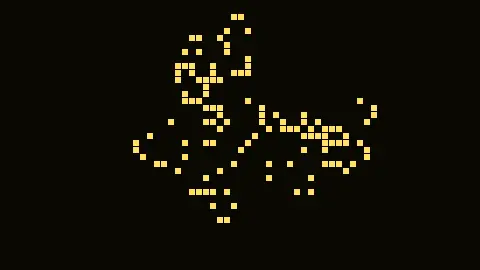
Press ESC to leave fullscreen. Settings are saved in your browser only.
How the Seeds Automaton screensaver works
The rule is deliberately brutal: every live cell dies next generation, unconditionally — there is no survival condition at all.
The only way cells persist is through birth: a dead cell becomes alive if it has exactly 2 live neighbors right now.
Because death is total but birth is easy to trigger, small seeds explode outward into branching, exploratory filaments rather than fading out.
The pattern never reaches a stable still life — every generation is entirely freshly born cells, chasing outward from wherever the last generation touched.
A rule with no survivors that still grows
Seeds belongs to the family of cellular automata called Life-like, because they use the same square grid and the same eight-neighbour counting as Conway's Game of Life, but with different birth and survival numbers. Seeds was initially investigated by Brian Silverman and later named by Mirek Wójtowicz. Written in the common B/S notation, its rule is B2/S, with nothing after the slash: no live cell ever survives.
That sounds like a recipe for extinction, yet the opposite happens. Since every cell dies after one step, the grid always shows only the cells born this generation, and a dead cell is born whenever it has exactly two live neighbours. Two nearby cells therefore create offspring around them, which create more, and the pattern expands as a crackling front of short-lived dots rather than a blob of persistent matter.
Because nothing survives, no pattern can stay unchanged from one generation to the next, so Seeds has no still lifes at all. It is a good example of how a dramatic outcome can come from a rule even simpler than Life's, and of why small changes to a rule's numbers can produce a completely different universe.
A worked example
Drop in a small cluster and watch it detonate outward in a matter of generations, throwing off branching arms in every direction — nothing from the previous generation survives, yet the pattern keeps spreading rather than vanishing.
Settings & tips
- Cell color recolours every freshly born cell.
- Generations / sec controls how fast the bloom spreads.
- The board reseeds with a fresh seed once growth reaches the edges.
Frequently asked questions
- How can it keep growing if every cell dies each turn?
- Because the birth rule (exactly 2 neighbors) fires often enough near recently-active cells that new cells keep being born faster than the pattern can vanish.
- Does it ever go still?
- Rarely — the rule structurally favors explosive spread over stability, unlike Conway's Life.
- Is a key needed?
- No — it's a pure local computation.
- Is it free?
- Yes — free, no download, in your browser.
- What does B2/S mean?
- It is shorthand: B2 means a dead cell becomes alive when it has exactly two live neighbours, and the empty S means no condition lets a live cell survive.
- Is Seeds related to Conway's Game of Life?
- It is a close cousin: same grid and same eight-cell neighbourhood, but different numbers in the birth and survival rules, which produce explosive growth instead of the stable shapes Life is known for.
- Why are there no still lifes?
- A still life is a pattern that stays the same from one generation to the next. In Seeds every live cell dies, so no pattern can repeat itself in place.