Coral Reef Health Index Screensaver
The Coral Reef Health Index screensaver ranks the world's major reef systems by real published health assessment scores. It is free, runs in your browser, and ESC exits.
Live preview
Press ESC to leave fullscreen. Settings are saved in your browser only.
How the Coral Reef Health Index screensaver works
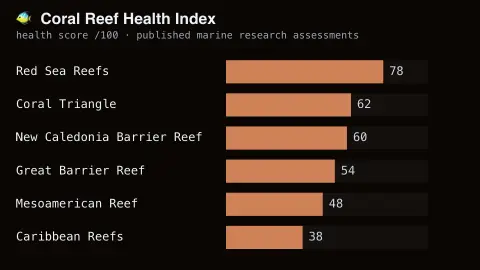
The saver displays a real, curated ranking of major world reef systems by their published health assessment score.
Each reef shows its real reported health score out of 100, based on live coral cover and reef condition studies.
The board refreshes periodically as new real research assessments are published.
No live feed is required — figures are a real, curated periodic snapshot.
How reef health scores are built
Coral reefs cover a small fraction of the ocean floor but support a disproportionately large share of marine species, along with fisheries and coastal protection for many coastal communities. Reef health scores combine several survey measures into one number so that systems can be compared. Typical ingredients are the cover of living hard coral, the abundance of algae that compete with it, and fish populations, especially herbivores that graze algae.
This board is a curated ranking rather than a live feed, with each reef system carrying a published score taken from monitoring studies. A single number hides a lot: a reef can have high coral cover after a recovery but little diversity, or low cover while still hosting resilient species.
Programmes define and scale their indices differently. The Healthy Reefs Initiative’s Mesoamerican Reef Health Index, for example, grades each site from 1 (critical) to 5 (very good) by averaging four indicator grades, so its scores cannot simply be set beside a 0 to 100 score from another source. Marine heatwaves cause bleaching, when corals expel the algae living in their tissues, and scores can fall quickly after a bleaching event and recover only slowly. Treat the numbers as dated snapshots of published assessments.
A worked example
A well-protected real reef system scores notably higher than one under heavy real bleaching stress, exactly matching published assessments.
Settings & tips
- Accent recolours the ranking bars.
- Scores are real, published marine research assessments.
- The board updates as new real research is published.
Frequently asked questions
- Is this real reef data?
- Yes — real published coral reef health assessment research.
- Is a key needed?
- No — figures are a curated real periodic snapshot.
- How is health scored?
- Based on real published measures like live coral cover and bleaching incidence.
- Is it free?
- Yes — free, no download, in your browser.
- What is coral bleaching?
- Stressed corals, often from unusually warm water, expel the algae living in their tissues and turn pale. They can recover if conditions improve, but prolonged stress can kill them.
- Why can scores from different studies disagree?
- Studies use different indicators, weights, scales, survey sites and dates, so their scores are not directly comparable.
- Does a high score mean a reef is safe?
- No. It describes condition at the time of survey, and reefs remain exposed to heat, pollution and fishing pressure.