Brian's Brain Screensaver
Brian's Brain is a three-state cellular automaton: off, firing, and dying. An off cell with exactly two firing neighbors ignites; any firing cell always becomes dying; any dying cell always turns off. Unlike Conway's Life, it almost never settles into stillness — the field keeps sparking indefinitely.
Live preview
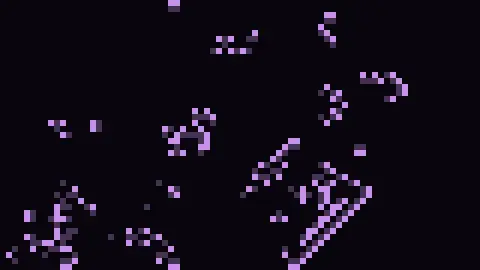
Press ESC to leave fullscreen. Settings are saved in your browser only.
How the Brian's Brain screensaver works
Every cell holds one of three real states: off, firing (bright), or dying (dim).
A firing cell always becomes dying next tick, no matter what. A dying cell always becomes off next tick, no matter what.
An off cell ignites into firing only if exactly two of its eight neighbors are currently firing.
Because firing and dying cells always change regardless of neighbors, the automaton almost never freezes — sparks keep reigniting new firing cells nearby.
Brian Silverman's Brain
Brian's Brain is a cellular automaton devised by Brian Silverman. Its rule is compact: three states (on, dying, off), and each cell looks at its eight neighbours, the square around it including diagonals, known as the Moore neighbourhood. It is closely related to the Seeds rule, whose birth condition it shares.
A cell that is off turns on only when exactly two neighbours are on. An on cell always moves to the dying state, and a dying cell always turns off. Dying cells do not count as neighbours for births, and the forced decay means nothing stays lit. The dying state tends to give patterns a direction, so almost every pattern is a spaceship, and many of them emit further spaceships or burst into chaotic diagonal waves.
This is the key contrast with Conway's Life, which has still lifes and slow oscillators that let large regions freeze. In Brian's Brain activity tends to persist, so a random start usually settles into a churning soup of moving shapes. Some descriptions compare the three states to a neuron that is ready, firing, or refractory, meaning briefly unable to fire again, which is the role the dying state plays here.
A worked example
Watch a bright firing cluster burn out to dim dying cells within two ticks, while fresh bright sparks ignite just beside it — the pattern never truly dies out, just keeps drifting and re-sparking across the grid.
Settings & tips
- Firing color recolours the bright ignited cells; dying cells are shown dimmer automatically.
- Generations / sec controls the animation speed.
- The board reseeds with fresh random sparks once activity gets too sparse.
Frequently asked questions
- Why doesn't it ever go still like Conway's Life?
- Because firing and dying cells change unconditionally every tick, the automaton structurally can't settle into a static pattern.
- Is a key needed?
- No — it's a pure local computation.
- Is it free?
- Yes — free, no download, in your browser.
- How is this different from Conway's Game of Life?
- Life has two states and can freeze solid; Brian's Brain has three states and its firing/dying rule keeps it perpetually active.
- What is a refractory state?
- It is a recovery period after activity in which an element cannot be excited again. The dying state plays this role in Brian's Brain: a cell that has just fired must pass through it before it can be off and ready to ignite again.
- What are the moving shapes in Brian's Brain?
- Mostly spaceships, patterns that travel across the grid. The dying state tends to give patterns a direction, so almost every pattern moves, and some emit further spaceships as they go.