Bitcoin Block Miner Screensaver
The Block Miner screensaver is a live view of the Bitcoin network — the mempool filling with unconfirmed transactions and fresh blocks being mined — with current fee rates, from the key-less mempool.space API. It's free, runs in your browser, and ESC exits.
Live preview
Press ESC to leave fullscreen. Settings are saved in your browser only.
How the Block Miner screensaver works
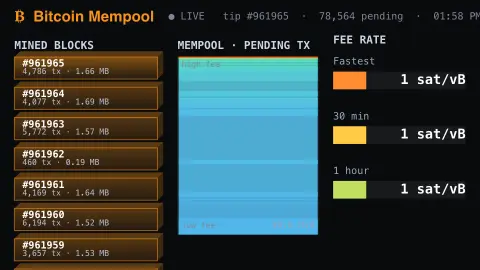
The saver polls mempool.space's free API for the latest mined blocks, the pending mempool, and recommended fee rates — no key needed.
Recent blocks are drawn as a row of stacked cubes labelled with height, transaction count and size; when a new block is mined, it slides in.
The mempool waiting area fills with bands built from the live fee histogram, low fees cool and high fees hot, so you can see congestion at a glance.
A small gauge shows the current fastest, 30-minute and 1-hour fee rates in sats per virtual byte.
Mempools, blocks and fee rates on Bitcoin
Bitcoin transactions do not take effect instantly. When someone broadcasts a payment, nodes hold it in their mempool, a waiting room of unconfirmed transactions, until a miner includes it in a block. Blocks arrive on average roughly every ten minutes, though individual gaps vary widely because mining is a probabilistic race. Each block has limited capacity, so miners generally pick the transactions that pay the most for the space they use.
That is why fees are quoted in satoshis per virtual byte (sat/vB). A satoshi is one hundred-millionth of a bitcoin, and block space is measured in weight units, with one virtual byte equal to four of them. When many people want to transact at once, the mempool backs up and the rate needed for quick confirmation climbs; when demand falls, even low rates clear quickly.
mempool.space is an open-source Bitcoin mempool and blockchain explorer that focuses on the transaction fee market, and its project describes itself as self-hosted without trusted third parties. Fee suggestions are estimates drawn from the current queue, not promises: a sudden rush or a block that arrives early or late can change the outcome. Each node keeps its own mempool, so contents differ slightly between observers. The display is descriptive and is not financial or transaction advice.
A worked example
You'll see the chain tip climb — say block #955,807 with ~1,340 tx — a new orange cube clattering in each time a block is found, while the mempool swells and shrinks and the fee gauge tracks how busy the network is.
Settings & tips
- Refresh sets how often the network data is re-fetched.
- Accent recolours the Bitcoin-orange highlights.
- Background sets the panel backdrop.
Frequently asked questions
- Is this live Bitcoin data?
- Yes. Blocks, mempool size and fee rates come live from mempool.space and update on the refresh interval you set.
- Does it need an API key or wallet?
- No. It uses the free, key-less mempool.space API and never touches any wallet. It only needs an internet connection.
- What are the fee numbers?
- They're recommended fee rates in sats per virtual byte — roughly what you'd pay for fast, 30-minute or 1-hour confirmation right now.
- Is any of this financial advice?
- No. It's a display of public network activity for ambiance, not advice of any kind.
- Is it free?
- Yes — free, no download, in your browser.
- Why do some transactions wait much longer than others?
- Miners generally prefer transactions that pay more per virtual byte. A low-fee transaction can sit in the mempool through several blocks while higher-paying ones are confirmed ahead of it.
- Why do blocks sometimes arrive minutes apart and sometimes seconds apart?
- Mining is a probabilistic race, so block times scatter around the ten-minute average. Several blocks can come quickly, or a long wait can occur, purely by chance.