Fee Gauge Screensaver
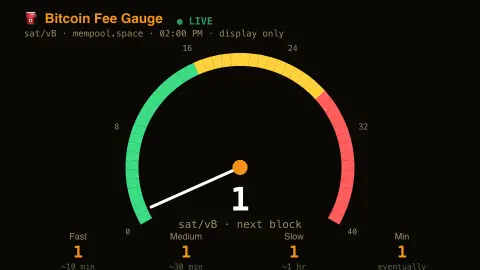
The Fee Gauge screensaver is a pressure gauge of Bitcoin network fees in sats per virtual byte; the needle climbs when the mempool is congested. From the key-less mempool.space API. It's free, runs in your browser, display only, and ESC exits.
Live preview
Press ESC to leave fullscreen. Settings are saved in your browser only.
How the Fee Gauge screensaver works
The saver fetches the recommended Bitcoin fee rates from the key-less mempool.space API.
It draws a pressure gauge whose needle eases to the current next-block fee in satoshis per virtual byte — green when calm, red when congested.
Below the dial it lists the fast, medium, slow and minimum tiers with their rough confirmation times.
It refreshes every 30 seconds, so the needle rises and falls with real network demand.
How Bitcoin fees are set by competition for space
Every Bitcoin block has limited room, so transactions compete to be included. Nodes hold valid, unconfirmed transactions in a waiting area called the mempool, and miners generally prefer those paying the most per unit of block space. A fee is therefore not a fixed price but the outcome of a continuous auction, and it rises when many people want to transact at once.
Block space is measured in weight units, and a virtual byte is four weight units, so a block holds at most one million virtual bytes. Fee rates are quoted in satoshis per virtual byte, where a satoshi is one hundred-millionth of a bitcoin. Because the cost is tied to the block space a transaction uses, not the amount of bitcoin it moves, a large payment can cost the same as a small one.
The tiers on the display come from the recommended-fees endpoint of the mempool.space API, which it describes as currently suggested fees for new transactions. They are estimates of what is likely to confirm within a given time, not guarantees. Fees are volatile and nothing here is a forecast or advice about when to transact.
A worked example
On a quiet night the needle sits low and green at 3 sat/vB; when a wave of transactions floods in it swings into the red past 80 sat/vB — the tier row showing fast, medium and slow fees pulling apart.
Settings & tips
- Accent recolours the needle and tiers.
- Background sets the dial backdrop.
- The gauge auto-scales so the needle always has headroom.
Frequently asked questions
- Are the fees live?
- Yes. They come from the mempool.space API and refresh every 30 seconds, so the gauge tracks real network demand.
- What is sat/vB?
- Satoshis per virtual byte — the price you pay per unit of transaction size. Higher fees confirm sooner when the network is busy.
- Is this investment advice?
- No. It's a display of public network data for ambiance, not advice of any kind.
- Does it need a key?
- No. The mempool.space API is free and key-less; the saver only needs an internet connection.
- Is it free?
- Yes — free, no download, in your browser.
- What is a satoshi?
- It is the smallest unit of bitcoin, equal to one hundred-millionth of a bitcoin. Fee rates are quoted in satoshis per virtual byte.
- Why does a transaction's size affect its fee?
- Block space is limited, so cost follows how much of it a transaction occupies, measured in virtual bytes, rather than how much bitcoin it moves.
- What is the mempool?
- It is the set of valid, unconfirmed transactions held by nodes while they wait for a miner to include them in a block. A large backlog usually means congestion.