Halving Countdown Screensaver
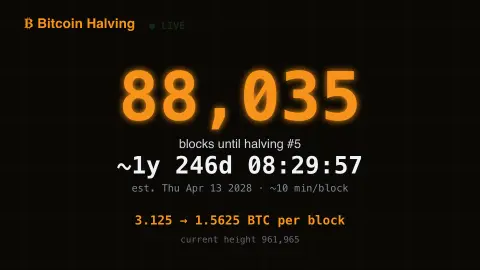
The Halving Countdown screensaver shows the blocks and estimated time until the next Bitcoin halving, from the live block height — the event that cuts the mining reward in half. From mempool.space, free, in your browser, and ESC exits.
Live preview
Press ESC to leave fullscreen. Settings are saved in your browser only.
How the Halving Countdown screensaver works
The saver reads the current Bitcoin block height live from the key-less mempool.space API.
It works out how many blocks remain until the next halving, which happens every 210,000 blocks.
At roughly ten minutes a block it estimates the date and shows a ticking countdown, plus the reward before and after.
It refreshes the height every minute, so the count creeps down as new blocks are mined.
Why Bitcoin's reward shrinks every 210,000 blocks
Bitcoin creates new coins through mining: roughly every ten minutes a miner who finds a valid block collects a block subsidy plus the fees from the transactions inside it. The protocol rule is simple. The subsidy started at 50 bitcoin per block and is cut in half after every 210,000 blocks, an event called the halving. At the April 2024 halving, block 840,000, it dropped from 6.25 to 3.125 bitcoin.
That schedule is what gives Bitcoin its supply limit of 21 million coins: because each halving shrinks new issuance, the total approaches the cap rather than growing forever. Eventually the subsidy will reach zero, and miners will depend entirely on fees.
The date shown here is an estimate rather than a promise. Block height is exact, but the time between blocks is random, and the network adjusts mining difficulty every 2016 blocks to keep the average near ten minutes. A run of fast or slow blocks, or a change in total mining power, moves the real date earlier or later than the projected one. Nothing on this page is a price prediction.
A worked example
The board reads tens of thousands of blocks remaining to halving #5, a ticking estimate of ~2y 140d, and the reward dropping from 3.125 → 1.5625 BTC — the four-yearly squeeze that defines Bitcoin's supply.
Settings & tips
- Accent recolours the counter.
- Background sets the backdrop.
- The time is an estimate at roughly ten minutes per block.
Frequently asked questions
- Is the block height live?
- Yes. It comes from the mempool.space API and refreshes every minute, so the remaining-block count is current.
- What is the halving?
- Roughly every four years (210,000 blocks) Bitcoin's mining reward is cut in half — a built-in tightening of new supply.
- Why is the date an estimate?
- Blocks average about ten minutes but vary, so the date is projected from that average and shifts slightly over time.
- Does it need a key?
- No. The mempool.space API is free and key-less; the saver only needs an internet connection.
- Is it free?
- Yes — free, no download, in your browser.
- How many halvings have happened so far?
- Four, in 2012, 2016, 2020 and 2024, each cutting the block subsidy in half from its original 50 bitcoin. The next occurs at the next multiple of 210,000 blocks.
- Why does the estimated date change?
- Block times vary randomly around a ten-minute average, so the projected date moves as the real pace of mining speeds up or slows down.
- What happens to miners when the reward falls?
- Their income from the subsidy declines, so transaction fees make up a larger share of what a block earns. Fees are set by users competing for block space, not by the protocol.