Hash Rate Monitor Screensaver
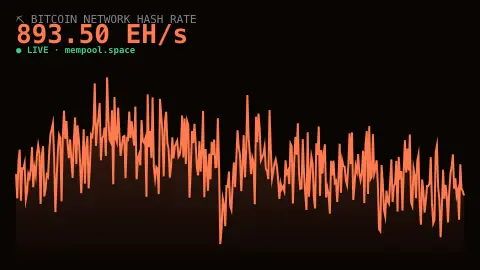
The Hash Rate Monitor screensaver charts Bitcoin's real network hash rate — the total computing power currently securing the chain — drawn key-less and live from mempool.space. It's free, runs in your browser, and ESC exits.
Live preview
Press ESC to leave fullscreen. Settings are saved in your browser only.
How the Hash Rate Monitor screensaver works
The saver fetches Bitcoin's real recent hash rate history from mempool.space, with no key required.
A line chart plots the network's real computing power over recent months.
The current estimated hash rate is shown as a large readout, in exahashes per second.
The chart refreshes on a schedule so the trend tracks real network growth.
Hash rate as an estimate, not a measurement
Bitcoin miners compete by repeatedly computing a cryptographic hash of a candidate block, hoping the result falls below a target value. Each attempt is an independent guess, with the same small chance of success. Hash rate is the rate of guessing, and one exahash per second is 10^18 hashes per second, a billion billion.
Nobody observes the figure directly, because miners do not report their attempts. It is inferred from difficulty and how quickly blocks are found. Finding a block at difficulty D takes about D × 2^32 hashes, so with a ten-minute (600 second) target interval the implied network hash rate is roughly D × 2^32 / 600. Difficulty is adjusted every 2,016 blocks, about two weeks if blocks arrive every ten minutes: slower than that lowers it, faster raises it.
Because block discovery is a random process, any short-run reading is noisy, and averaging over days or weeks gives a steadier curve. The number measures computing effort devoted to securing the chain. It says nothing directly about price, and its movements over a few weeks should not be over-read.
A worked example
You'll see a real, climbing line — Bitcoin's hash rate has grown for most of its history as more real mining hardware comes online worldwide.
Settings & tips
- Accent recolours the chart line.
- Hash rate is estimated from real block-discovery timing, the same method miners themselves use.
- A dip doesn't always mean trouble — regional power costs and weather shift it too.
Frequently asked questions
- What is hash rate?
- The total computational power miners worldwide are pointing at Bitcoin, measured in hashes per second — a real security metric, not a price.
- Is a key needed?
- No. mempool.space's public API is free and key-less.
- Is this exact or estimated?
- Hash rate can't be measured directly — it's estimated from real block-discovery times, the standard industry approach.
- Is it free?
- Yes — free, no download, in your browser.
- Why does the line look jagged?
- Because the figure is inferred from random block arrival times. Short windows swing up and down even when real mining power is steady, which is why longer averages look smoother.
- How often does difficulty change?
- Every 2,016 blocks, which takes about two weeks if blocks average ten minutes. It falls if the previous period was slower than that and rises if it was faster.
- What is an exahash?
- A unit equal to 10^18 hashes, or a quintillion. Hash rate in exahashes per second counts how many quintillions of hash attempts are made each second.