Ethereum Gas Tracker Screensaver
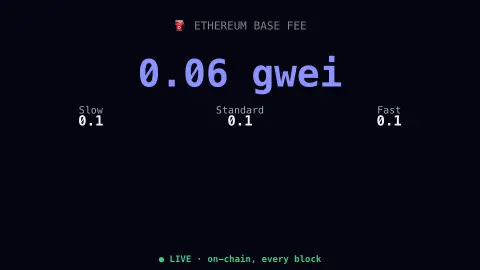
The Ethereum Gas Tracker screensaver gauges current Ethereum gas prices across speed tiers, read directly from the chain via a public RPC endpoint — no key and no third-party gas API. It's free, runs in your browser, and ESC exits.
Live preview
Press ESC to leave fullscreen. Settings are saved in your browser only.
How the Ethereum Gas Tracker screensaver works
The saver queries a public Ethereum RPC endpoint directly for the chain's real current base fee.
A gauge shows the real current gas price in gwei, with slow/standard/fast estimates derived from it.
A small trend line tracks how gas has moved over the last few minutes of real blocks.
Readings refresh every block, roughly every 12 seconds, in real time.
Gas, gwei and the Ethereum base fee
On Ethereum, every operation a transaction performs consumes gas, a unit that measures computational effort. A simple transfer needs a fixed amount, while a complicated contract interaction needs much more. The price per unit of gas is quoted in gwei, one billionth of an ether, so the total cost of a transaction equals gas used multiplied by the gas price.
Since the London upgrade went live on 5 August 2021, each block carries a base fee that is set by protocol rules rather than by a bidding war. The target block size is half the gas limit, and blocks can grow to twice the target. If the previous block was above target the base fee for the next one rises, and if it was below target it falls, by at most 12.5% per block. The base fee is burned, removed from circulation instead of paid to validators. Users can add a priority tip on top, which goes to the validator and makes a transaction more attractive for inclusion.
This is why the gauge moves in steps that follow block fullness, and why fees spike when sustained demand fills blocks several times in a row. The figure shown is the network price for the next block. What a wallet quotes can differ, since it also adds a tip, and the fee for any given action depends on how much gas that action needs.
A worked example
During a busy period you'll see the real gwei readout climb sharply — genuine network demand pushing up the price of block space, not a simulated spike.
Settings & tips
- Accent recolours the gauge needle.
- Gas moves fast — refreshing every block keeps it current.
- Reading straight from the chain means no third-party gas API can go stale or rate-limit you.
Frequently asked questions
- Is this from Etherscan?
- No — it reads Ethereum's real base fee directly from the chain via a public RPC node, with no third-party gas API or key involved.
- Is a key needed?
- No. Public Ethereum RPC endpoints are free and key-less for light use.
- How often does gas change?
- Every block — roughly every 12 seconds — tracking real network demand.
- Is it free?
- Yes — free, no download, in your browser.
- What is a gwei?
- One billionth of an ether, or a billion wei. Gas prices are quoted in gwei because ether itself is too large a unit for such small amounts.
- Why do fees spike?
- When blocks are above target, the base fee rises by up to 12.5% each block, so sustained demand makes the price compound upward quickly before it eases.
- Do layer-2 networks have the same gas price?
- No. Layer-2 networks have their own fee markets, and what they charge is usually far lower than mainnet, though part of it reflects the cost of posting data to Ethereum.