Exchange Netflow Screensaver
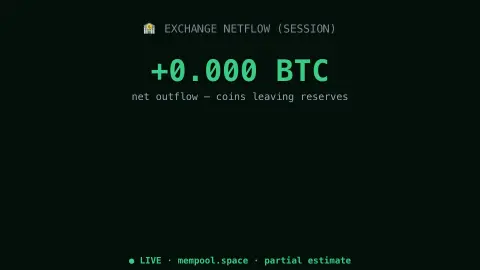
The Exchange Netflow screensaver gauges the estimated net Bitcoin flow into or out of major exchange wallets, built from real, publicly attributed exchange address balances via mempool.space. It's free, runs in your browser, and ESC exits.
Live preview
Press ESC to leave fullscreen. Settings are saved in your browser only.
How the Exchange Netflow screensaver works
The saver polls a curated list of publicly attributed exchange wallet addresses via mempool.space, with no key required.
Balance changes between polls are summed into a live net inflow or outflow estimate.
A gauge leans toward inflow (often read as bearish) or outflow (often read as bullish) accordingly.
This is a real but partial estimate — see the FAQ for its limits.
Reading exchange netflow as a signal
Exchange netflow is an on-chain metric: the difference between the coins arriving at exchange-controlled addresses and the coins leaving them. Analysts often read a sustained rise in exchange balances as potential sell-side supply and a sustained fall as coins moving into self-custody. That reading is a heuristic, not a rule, and it is a market convention rather than something the blockchain itself records.
The hard part is attribution. A blockchain address carries no label, so any list of exchange wallets comes from outside sources such as public disclosures and analysts’ own clustering of addresses. Exchanges can also move funds between their own wallets, which can look like a flow even though no customer did anything. Wallets that are not on the list are invisible to the gauge.
Treat the needle as a rough mood indicator for the addresses being watched rather than a measurement of the whole market. Large deposits can be internal reshuffles, withdrawals can be restocking, and neither says anything dependable about where the price goes next. Nothing here is investment guidance.
A worked example
A run of real outflows nudges the gauge toward withdrawals — coins moving off exchanges, a pattern some traders watch as a signal, though it's only ever a partial picture.
Settings & tips
- Accent recolours the gauge.
- Publicly attributed addresses are a known subset — real exchange holdings are larger and partly unlisted.
- Treat the gauge as a directional signal, not an exact total.
Frequently asked questions
- Is this every exchange wallet?
- No — only publicly attributed addresses are trackable; real total exchange holdings are larger and partly unknown.
- Is a key needed?
- No. mempool.space's public API is free and key-less.
- Why do people watch this?
- Sustained outflows are sometimes read as holders moving to self-custody; sustained inflows sometimes precede selling — real correlations, not guarantees.
- Is it free?
- Yes — free, no download, in your browser.
- Why can a big inflow be meaningless?
- Exchanges can move coins between their own wallets, and an internal transfer can look like a deposit or withdrawal depending on which addresses are tracked.
- Does an outflow always mean people are holding long term?
- No. Coins leaving an exchange may go to self-custody, but they can equally go to another venue, a lender or a payment processor, so the direction alone does not reveal intent.
- Why is netflow only an estimate?
- Address labels are incomplete and can change, so the true total across every exchange is unknown. The gauge reflects only the wallets that have been attributed.