Ethereum Burn Tracker Screensaver
The Ethereum Burn Tracker screensaver gauges Ethereum's real base-fee burn rate live, with a running session tally of ETH burned since you started watching, read directly from the chain via a public RPC endpoint. It's free, runs in your browser, and ESC exits.
Live preview
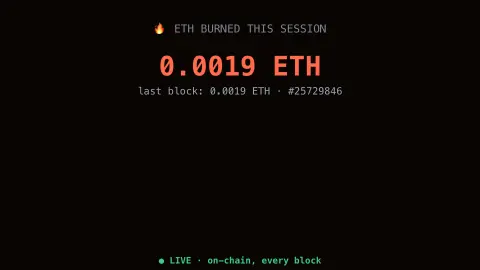
Press ESC to leave fullscreen. Settings are saved in your browser only.
How the Ethereum Burn Tracker screensaver works
Every new block, the saver reads the real base fee and gas used directly from a public Ethereum RPC endpoint.
Multiplying those gives the real ETH burned in that block under Ethereum's EIP-1559 rule.
A running session total accumulates burned ETH for as long as you've been watching.
The gauge and tally update every block, roughly every 12 seconds.
EIP-1559 and the base-fee burn
Before the London upgrade of 5 August 2021, Ethereum transaction fees were set by a straightforward auction: users bid, and block producers took the whole fee. London introduced EIP-1559, which splits a fee in two. A protocol-set base fee is burned, and an optional priority tip is paid to the validator. The base fee is calculated from earlier blocks and moves automatically: each block's target size is half the gas limit, and the base fee rises when a block is above target and falls when it is below, by up to 12.5% per block.
Burning matters because it removes ETH from circulation. Whether the supply shrinks overall depends on how the amount burned compares with new issuance paid to validators, and either side can dominate at different times.
The burned amount in a given block is the base fee per unit of gas multiplied by the gas the block used. Base fees are quoted in gwei, one billionth of an ETH. Because the base fee responds to demand block by block, a short window of blocks is a poor guide to long-term trends. Nothing here is a price view.
A worked example
During a busy stretch you'll see the per-block burn spike — real transaction demand destroying more ETH than during a quiet period, live off the chain itself.
Settings & tips
- Accent recolours the burn gauge.
- The session tally starts at zero when you open the saver — it isn't the all-time historical total.
- Since EIP-1559, a portion of every transaction fee is permanently destroyed, not paid to miners.
Frequently asked questions
- Is this the all-time total burned?
- No — the running tally is a real live session total starting from when you opened the saver, not Ethereum's full historical burn.
- Is a key needed?
- No. Public Ethereum RPC endpoints are free and key-less for light use.
- Why does Ethereum burn ETH?
- Since the EIP-1559 upgrade, part of every transaction's base fee is destroyed rather than paid out, a real deflationary mechanism.
- Is it free?
- Yes — free, no download, in your browser.
- What is gwei?
- A unit used for gas prices, equal to one billionth of an ETH.
- Where does the tip go?
- The priority tip is paid to the validator, while the base fee is burned and removed from circulation.
- Does burning make ETH more valuable?
- Burning reduces supply, but price depends on many other factors including demand, so the burn rate is not a reliable predictor.