Dormant Wallet Watch Screensaver
The Dormant Wallet Watch screensaver watches a curated set of famous, long-dormant early Bitcoin addresses and flags the rare moment any of them moves, drawn key-less and live from mempool.space. It's free, runs in your browser, and ESC exits.
Live preview
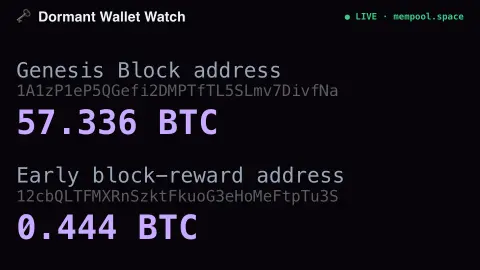
Press ESC to leave fullscreen. Settings are saved in your browser only.
How the Dormant Wallet Watch screensaver works
The saver polls a curated list of publicly known, historically dormant Bitcoin addresses via mempool.space, with no key required.
Each address shows its real current balance and how long it's held it untouched.
If a watched address ever moves, it's flagged prominently — a genuinely rare event.
Balances refresh on a schedule so the display stays current.
Dormant addresses on the Bitcoin ledger
Bitcoin's ledger is public. Coins sit in transaction outputs tied to addresses, and anyone can look up an address's balance and its transaction history. An address is dormant when its coins have not moved for a long time. A few are famous because they date from the network's earliest years.
Dormancy is not proof that coins are lost. The owner may be holding them deliberately, may have misplaced the keys, or may have died without passing them on, and the ledger records only the balance and the activity, never the person. Nobody can tell from the chain which explanation is true, and claims about whose wallet it is are speculation unless the owner has publicly said so.
mempool.space is the public instance of Mempool, an open-source (AGPL-3.0) Bitcoin explorer, visualizer and API service that shows balances and transactions, including those not yet confirmed. Watching old addresses is a popular pastime because movement from one would be newsworthy, even though it does not by itself indicate a sale or a particular motive. Balances are counted in satoshis, one hundred millionth of a bitcoin.
A worked example
Most of the time every address reads the same real balance it's held for over a decade — the watch is quiet by design, which is exactly the point.
Settings & tips
- Accent recolours the balance readouts.
- These are real, publicly attributed early addresses, not random wallets.
- A move after years of silence is a genuinely notable on-chain event, widely discussed when it happens.
Frequently asked questions
- Whose wallets are these?
- A curated set of publicly documented, historically significant early Bitcoin addresses that have sat untouched for years.
- Is a key needed?
- No. mempool.space's public API is free and key-less.
- Do these ever actually move?
- Rarely — that rarity is exactly what makes it worth watching; it does happen occasionally and is real news when it does.
- Is it free?
- Yes — free, no download, in your browser.
- How can a balance be seen without the owner's name?
- Bitcoin addresses are pseudonymous: balances and transactions are public, but the link to a real identity exists only if the owner reveals it or others piece it together.
- Do coins in dormant wallets count toward supply?
- Yes, they exist and are part of the total issued, but if the keys have been lost they are effectively out of circulation.
- What is a satoshi?
- The smallest unit of bitcoin, one hundred millionth of a coin (100,000,000 satoshis make one bitcoin).