Mining Difficulty Watch Screensaver
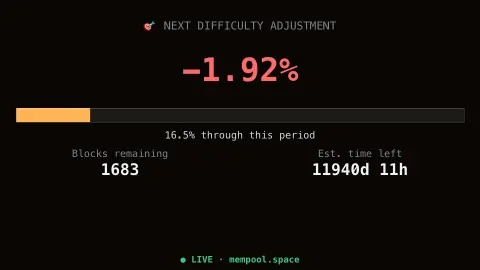
The Mining Difficulty Watch screensaver shows Bitcoin's current real mining difficulty and a live estimate of the next automatic adjustment, drawn key-less from mempool.space. It's free, runs in your browser, and ESC exits.
Live preview
Press ESC to leave fullscreen. Settings are saved in your browser only.
How the Mining Difficulty Watch screensaver works
The saver fetches the real current difficulty and recent block timing from mempool.space, with no key required.
A progress bar fills toward the next real difficulty adjustment, which happens every 2016 blocks.
An estimated percentage change is shown, based on how fast recent real blocks have been found.
Readings refresh on a schedule to track real network conditions.
What Bitcoin mining difficulty does
Bitcoin miners compete to find a block header hash at or below a target number. Difficulty is a measure of how hard it is to find a hash below that target, defined as the difficulty-1 target divided by the current target. The protocol aims for one block roughly every ten minutes, so if more computing power joins the network, blocks arrive faster than planned and difficulty rises; if power leaves, it falls.
Difficulty changes every 2016 blocks, which is about two weeks if blocks keep to schedule. The adjustment depends on how long the previous 2016 blocks took compared with the two-week ideal. The estimate on screen is a projection from recent block times, so it shifts as blocks arrive faster or slower than average until the adjustment locks in.
Difficulty measures mining competition, not price. It tends to follow hash rate with a lag, since adjustments occur only at fixed points. A drop can follow miners going offline for any reason, while a rise follows more hash power joining, for example from newer hardware. The number is a ratio relative to difficulty 1, the easiest target allowed on the main network, which is encoded as 0x1d00ffff in the block header's nBits field.
A worked example
If blocks have been found faster than the real 10-minute target, you'll see a positive estimated change — difficulty is about to rise to bring block time back to normal.
Settings & tips
- Accent recolours the progress bar.
- The estimate can swing until the adjustment actually locks in.
- Difficulty adjusts automatically — no one decides it manually.
Frequently asked questions
- How often does difficulty adjust?
- Every 2016 blocks, roughly every two weeks, automatically, based on real recent block timing.
- Is a key needed?
- No. mempool.space's public API is free and key-less.
- Why does the estimate change?
- It's a live projection from real blocks found so far in the current period — it firms up as the period completes.
- Is it free?
- Yes — free, no download, in your browser.
- Why does the estimated change keep moving?
- Block arrival times are random. If recent blocks come faster than ten minutes apart, the projection rises, and slower stretches pull it down until the adjustment happens.
- Does higher difficulty mean the price will rise?
- No. Difficulty reflects how much computing power is competing to find blocks, not market price.