Birth & Death Rate Clock Screensaver
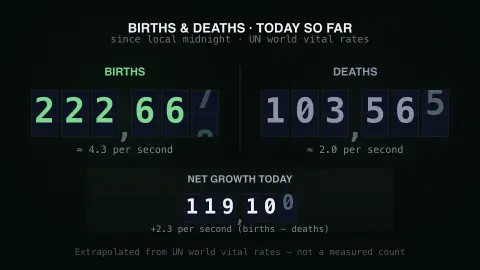
The Birth & Death Rate Clock shows two rolling odometers side by side — births and deaths worldwide since your local midnight — with the net growth counter ticking between them, extrapolated from United Nations vital rates. It's free, runs fully offline in your browser, and ESC exits.
Live preview
Press ESC to leave fullscreen. Settings are saved in your browser only.
How the Birth & Death Rate Clock screensaver works
Embedded UN world vital rates — about 4.3 births and 2.0 deaths per second — are the same constants as this site's Population Clock, so the two savers always agree.
Each side multiplies its rate by the seconds elapsed since your local midnight, so the counters reset to zero as your day starts.
The digits are drawn as mechanical reels: the lowest digit rolls continuously so you can watch every single birth and death land.
Everything is computed on your device — no network, no API — and the on-screen footnote is honest that these are extrapolations, not measured counts.
Counting births and deaths per second
Nobody observes every human birth and death as it happens. Instead, demographers combine data sources such as censuses and surveys into estimates, and the United Nations Population Division publishes them in its World Population Prospects, whose 2024 Revision drew on more than 1,900 national censuses. Dividing a year's estimated births or deaths by the number of seconds in a year gives a per-second rate, which is what this clock extrapolates.
Because it is an average over a whole year, the rate is smooth and steady, whereas real events cluster by time of day, season and region. The clock also does not respond to events, such as a pandemic or a famine, which can change the totals. The UN itself publishes several projection variants and uses a probabilistic approach for fertility and migration, a reminder that these figures are estimates with a range.
The gap between births and deaths is the natural increase of world population, and it is only part of the picture for individual countries, where migration also matters. Treat the odometers as a way to feel the scale of human numbers rather than as a measured tally.
A worked example
Open it at 6 p.m. and the green side reads about 278,600 births against 129,600 deaths on the slate side, the net strip near 149,000 and climbing 2.3 every second. Run it beside the Multi-view Population Clock to watch the flows and the running world total tick in perfect sync.
Settings & tips
- Deaths color — the right-hand side defaults to a muted slate; switch it to a soft red like
#ff8a7aif you want a starker contrast.
Frequently asked questions
- Are these real, live counts?
- They're honest extrapolations, not measurements — no one counts births in real time. The saver multiplies the UN's world vital rates by the seconds elapsed today, which is how demographic clocks everywhere work.
- How is this different from the Population Clock?
- The Population Clock shows one number: the running world total. This is the flows view — births and deaths separated into facing odometers with the day's net growth between them. Same UN rates underneath, so they never disagree.
- Does it work offline?
- Yes, completely. The rates are embedded in the saver and everything is computed on your device — it never touches the network.
- Does it need an API key?
- No. There's no feed and no key; the UN rates ship inside the saver itself.
- Is it free?
- Yes — free, no download, in your browser. ESC exits at any time.
- Why do the counters start from your local midnight?
- Resetting each day gives a human-sized number to watch grow, rather than an ever-larger cumulative total. It is a presentation choice, not a feature of the underlying data.
- Why is world population still growing if fertility is falling?
- Because many people are in or approaching their childbearing years, births can still outnumber deaths even when the average family is smaller. This lag is called population momentum.
- How accurate are global birth and death estimates?
- They are better at the level of the world and large countries than where data are sparse. The UN publishes projection variants and probabilistic treatment to reflect uncertainty.