World Language Population Ranking Screensaver
The World Language Population Ranking screensaver ranks the world's most-spoken languages by real published native-speaker counts on a bar board. It's free, runs in your browser, and ESC exits.
Live preview
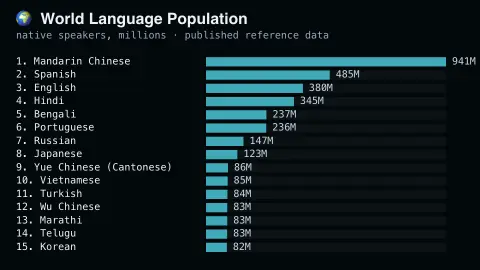
Press ESC to leave fullscreen. Settings are saved in your browser only.
How the World Language Population Ranking screensaver works
Languages rank top to bottom by real published native-speaker estimates.
Each bar is sized to scale against the largest language by speaker count.
Choose how many languages appear on the board at once.
Figures are real published linguistic reference data, updated periodically.
Counting the speakers of a language
Language rankings are harder to compile than they look. Native speakers, those who learned a language as a first language (L1), are a different group from total speakers, who include people using it as a second language (L2). Mandarin Chinese leads on the native count, while English leads on total speakers once its large second-language population is added, so which statistic a chart uses changes the order. Ethnologue-based figures, for example, put English’s total at roughly 1.5 billion, mostly second-language users.
Counts come from national censuses, surveys and linguistic reference works such as Ethnologue, and each has limits. Many censuses do not ask about language at all, and questions differ between countries. Whether closely related varieties count as one language or several, as with the varieties of Chinese or Arabic, is a matter of definition rather than a fact of linguistics, and reference works make different choices.
For all these reasons, the numbers are best treated as rounded estimates and the rankings as approximate, especially among neighbouring languages with similar totals. Figures also differ between editions of the same reference work and drift as populations grow, as people shift languages and as sources are updated.
A worked example
At the top you'll see languages like Mandarin, Spanish and English — the real current leaders by native-speaker count, each bar reflecting published linguistic reference figures.
Settings & tips
- Languages shown sets how many bars appear.
- Accent recolours the bars.
- Speaker counts are real published estimates, not a live census.
Frequently asked questions
- Where do the figures come from?
- Published linguistic reference sources on native-speaker populations, updated periodically as new estimates are released.
- Is a key needed?
- No — it's a static, real-reference-data visualization with no live fetch.
- Native speakers or total speakers?
- Native speakers — a different, usually smaller number than total speakers including second-language users.
- Is it free?
- Yes — free, no download, in your browser.
- Which languages count as 'Chinese' in the ranking?
- Chinese is a group of related varieties. Rankings often list Mandarin separately from others such as Cantonese or Wu, and how varieties are grouped changes the totals.
- Why does English rank differently in different lists?
- Ranked by native speakers it sits below Mandarin and some other languages, but counting people who speak it as a second language puts it first. The lists use different definitions.
- How accurate are the speaker counts?
- They are estimates. Censuses often do not ask about language, and definitions differ, so numbers are generally rounded and vary between reference works and editions.