Language Popularity Pulse Screensaver
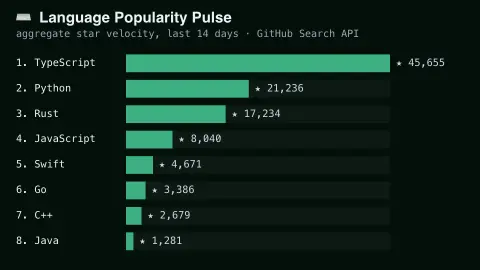
The Language Popularity Pulse screensaver ranks programming languages by real aggregate recent GitHub activity on a live board, drawn key-less from GitHub's public search API. It's free, runs in your browser, and ESC exits.
Live preview
Press ESC to leave fullscreen. Settings are saved in your browser only.
How the Language Popularity Pulse screensaver works
The saver queries GitHub's public search API for real repositories created recently in each major language, with no key required.
Languages rank by aggregate real star velocity across all matching repositories.
The board eases smoothly if the ranking shifts on refresh.
Readings refresh on a schedule to track real ecosystem momentum.
What GitHub star velocity measures
GitHub lets users star a repository, a lightweight way to bookmark it or signal approval. The saver queries GitHub’s public search API for recently created repositories in each language and adds up their stars, so the board reflects which languages are collecting attention among new projects instead of the size of old codebases. Repository search can be sorted by stars, and the language is matched with the language: qualifier.
GitHub detects a file’s language with its Linguist library, which uses strategies such as filename, file extension and heuristics, and a repository’s language breakdown is based on file size. A repository can override detection with a .gitattributes setting, so the label is not always a perfect description of the code.
A star is a measure of interest, not of use. A tutorial or a viral demo can gather many stars without anyone building on it, while a quiet but heavily used library may have few. The search API returns up to 1,000 results per search and limits unauthenticated clients to 10 search requests per minute, so the ranking is a snapshot of a sample. That is useful for spotting momentum but not for deciding which language to learn, hire for or invest in.
A worked example
You'll see languages like Python, TypeScript and Rust trading positions — a real aggregate signal of where new open-source energy is concentrated right now.
Settings & tips
- Accent recolours the bars.
- This ranks languages in aggregate — see GitHub Trending for individual standout repositories.
- Rankings reflect new-repository activity, not total historical codebase size.
Frequently asked questions
- Is a key needed?
- No — GitHub's public search API allows free, key-less light use.
- How is this different from GitHub Trending?
- GitHub Trending lists individual fast-rising repositories; this aggregates activity into a ranked language-level board.
- Is it free?
- Yes — free, no download, in your browser.
- Does it cover every language?
- It tracks a curated set of major, widely used programming languages.
- Does a high rank mean a language is more widely used?
- No. It reflects attention paid to new repositories, which can be driven by a few viral projects, not by the number of programmers or jobs.
- How does GitHub decide a repository’s language?
- It uses its Linguist library, which looks at things like filenames, extensions and heuristics, and a repository’s language breakdown is based on file size.
- Why can the ranking change so quickly?
- Because the board sums stars on a sample of new repositories, a single viral project can shift a language’s total and the order.