World Heritage Map Screensaver
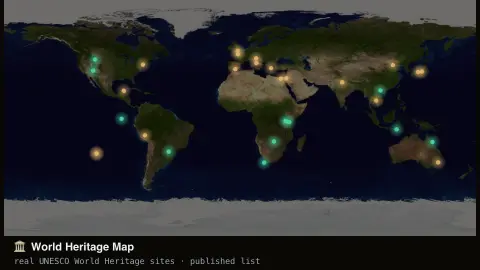
The World Heritage Map screensaver plots real UNESCO World Heritage sites worldwide — officially recognized places of outstanding cultural or natural value. It's free, runs in your browser, and ESC exits.
Live preview
Press ESC to leave fullscreen. Settings are saved in your browser only.
How the World Heritage Map screensaver works
The map is shaded using UNESCO's real published World Heritage List.
Each point represents a real inscribed site, coloured by cultural or natural designation.
Filter to cultural or natural sites only, or see the full real list.
Points slowly pulse to keep the display alive without implying live change.
How a place becomes a World Heritage site
The World Heritage List grows out of the 1972 UNESCO convention concerning the protection of the world’s cultural and natural heritage. A country that has signed the convention (a State Party) nominates sites within its own territory, and the intergovernmental World Heritage Committee decides whether to inscribe them. Candidates are evaluated beforehand by advisory bodies: ICOMOS for cultural sites and IUCN for natural ones, with ICCROM advising on conservation.
To be inscribed, a site must have Outstanding Universal Value and meet at least one of ten published criteria. Criteria (i) to (vi) concern cultural value, such as a masterpiece of human creative genius or exceptional testimony to a cultural tradition or civilisation, and (vii) to (x) concern natural value, such as superlative natural phenomena or significant habitats for biodiversity. Sites that meet criteria from both groups are called mixed sites. Inscription also requires conditions of integrity and, for cultural sites, authenticity, plus adequate protection and management.
On a map each site is reduced to a single point, although many are large areas, and some, called serial properties, consist of several separate components. The List of World Heritage in Danger is a separate list for inscribed sites facing serious threats.
A worked example
Zoom your attention to Europe and the Mediterranean and you'll see real dense clusters of inscribed sites — genuine UNESCO designations, not illustrative markers.
Settings & tips
- Show narrows the map to cultural or natural sites.
- Accent recolours the map points.
- This is real, published reference data — new sites are added roughly once a year.
Frequently asked questions
- How many World Heritage sites are there?
- UNESCO's real published list has grown past 1,200 sites across more than 160 countries.
- Is a key needed?
- No — it's a static, real-reference-data visualization with no live fetch.
- Is this official?
- Yes — it uses UNESCO's own published World Heritage List.
- Is it free?
- Yes — free, no download, in your browser.
- What are the ten criteria?
- They are the tests the Committee applies to judge Outstanding Universal Value. Criteria (i) to (vi) concern cultural value and (vii) to (x) concern natural value, and a site must satisfy at least one.
- Can a site be removed from the list?
- Yes. Three sites have been deleted entirely: the Arabian Oryx Sanctuary in Oman (2007), the Dresden Elbe Valley in Germany (2009) and Liverpool Maritime Mercantile City in the UK (2021), each after losing the qualities for which it was inscribed. Placing a site on the List of World Heritage in Danger is a separate, earlier warning step.
- Why are some countries so heavily represented?
- Sites are nominated by the governments of States Parties, so representation reflects how many places a country has put forward and had accepted, as well as its history and geography.