Passport Power Ranking Screensaver
The Passport Power Ranking screensaver ranks the world's passports by real visa-free destination count on a bar board, based on published global mobility index data. It's free, runs in your browser, and ESC exits.
Live preview
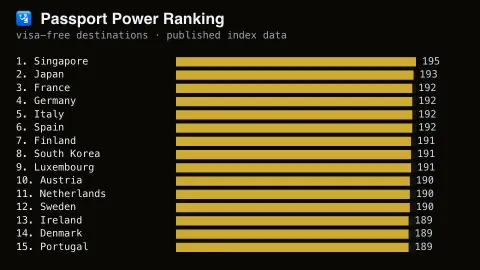
Press ESC to leave fullscreen. Settings are saved in your browser only.
How the Passport Power Ranking screensaver works
Passports rank top to bottom by real published visa-free and visa-on-arrival destination counts.
Each bar is sized to scale against the strongest passport.
Choose how many countries appear on the board at once.
Figures are real published mobility index data, updated periodically as visa policies change.
How passport power is measured
Passport rankings count how many destinations a passport holder can enter without applying for a visa in advance. The Henley Passport Index ranks passports by the number of destinations their holders can reach without a prior visa, and says it is updated monthly. Its base data comes from the International Air Transport Association (IATA), supplemented by its own research and open sources, and it checks each passport against 227 destinations.
The treatment of visa-on-arrival and electronic travel authorisations is the main source of difference between indexes. Henley scores a visa on arrival as visa-free only if no pre-departure government approval is needed, counts an electronic travel authorisation (ETA) as visa-free, and treats an e-visa as a visa requirement. Arton Capital’s Passport Index is described on its own site as counting visa on arrival, eTA and quickly issued eVisas as visa-free. Because publishers draw these lines differently, a gap of a few destinations is often down to method.
A count says nothing about how welcome a traveller is. It ignores how long you may stay, whether onward tickets are required, and how hard a visa is when one is needed. Entry rules change often, so check the official government source before planning travel.
A worked example
At the top you'll typically see passports from Asia and Europe granting well over 180 real visa-free destinations — a genuine published ranking, not an estimate.
Settings & tips
- Countries shown sets how many bars appear.
- Accent recolours the bars.
- Visa policies change often — figures are a real snapshot, not live.
Frequently asked questions
- Where does the data come from?
- Published global passport mobility index data compiled from real visa policy sources.
- Is a key needed?
- No — it's a static, real-reference-data visualization with no live fetch.
- How often does the ranking change?
- Real visa policy changes shift it periodically; the figures here update on the same cadence.
- Is it free?
- Yes — free, no download, in your browser.
- Why do different passport indexes give different numbers?
- They define visa-free access differently. Henley, for example, counts an electronic travel authorisation as visa-free but an e-visa as a visa requirement, while other indexes group these cases differently, and indexes update on different schedules.
- Does a higher rank mean easier travel everywhere?
- Not necessarily. The count ignores permitted length of stay, extra entry conditions and the difficulty of visas for places that still require one.
- Where should I check current entry rules?
- Check the official immigration or foreign-affairs pages of the destination country, as ranking tables are not a substitute for current rules.