Wireworld Screensaver
Wireworld is a cellular automaton with four real states — empty, wire, electron head and electron tail. Electron heads move forward along wires each tick, leaving a tail behind, and wires with exactly one or two head neighbors become heads themselves — simple rules that are powerful enough to build real working logic gates.
Live preview
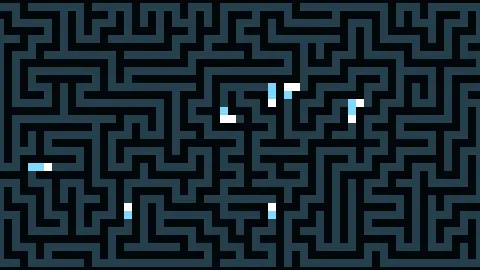
Press ESC to leave fullscreen. Settings are saved in your browser only.
How the Wireworld screensaver works
Every cell is one of four states: empty, conductive wire, an electron head, or an electron tail.
Each tick, an electron head always becomes a tail; a tail always becomes ordinary wire.
A wire cell becomes a new electron head only if exactly one or two of its neighbors are currently electron heads — otherwise it stays wire.
That single rule is enough to route, split, merge and even gate real streams of "electrons" — which is why Wireworld can build genuine logic circuits.
Silverman's four-state universe for building circuits
Wireworld is a cellular automaton proposed by Brian Silverman in 1987 as part of his Phantom Fish Tank program, and made widely known by A. K. Dewdney's Computer Recreations column in Scientific American in January 1990. Rather than relying on gliders and guns to emerge, a user draws conductor paths on a grid and sends electrons along them.
The four states are empty, wire, electron head and electron tail. A head always becomes a tail, a tail always becomes wire, and a wire cell turns into a head if exactly one or two of its eight neighbours (the Moore neighbourhood) are heads. Every other situation leaves the cell unchanged. With this small rule set you can build clocks that emit regular pulses, diodes that let signals pass one way only, and logic gates.
Those components are enough to assemble far larger machines. Wireworld is Turing-complete, and Mark Owen built a Wireworld computer, a Turing-complete computer implemented as a cellular automaton. The preset circuit in the display is a small taste of that: a path of conductors with signals chasing around it.
A worked example
Watch a bright electron head race along a wire trail, always followed one tick behind by a dimmer tail. Where two wires cross or merge, watch how heads combine or cancel depending on the exact timing — the same behavior real Wireworld logic gates depend on.
Settings & tips
- Electron color recolours the moving heads and their dimmer tails.
- Ticks / sec controls how fast the simulation advances.
- The board reseeds with a fresh wire layout once activity dies down.
Frequently asked questions
- Can Wireworld really compute?
- Yes — its rules are Turing-complete; hobbyists have built real adders and even small CPUs from wire layouts like this one.
- What are the four colors?
- Background (empty), wire, a bright electron head, and a dimmer trailing electron tail.
- Is a key needed?
- No — it's a pure local computation.
- Is it free?
- Yes — free, no download, in your browser.
- What is a diode in Wireworld?
- It is a specific arrangement of wire cells that lets an electron pass in one direction but blocks it in the other, the way an electronic diode controls current.
- How is Wireworld different from Conway's Life?
- In Wireworld you lay out wires and clocks as you would a circuit, and the rules move signals along them. It also has four states, where Life has two, and its rule counts electron heads among the eight neighbours.
- Is Wireworld Turing-complete?
- Yes. It is Turing-complete, and a Wireworld computer has been built by Mark Owen from wires, clocks and gates.