Which Wikipedia Is Growing Screensaver
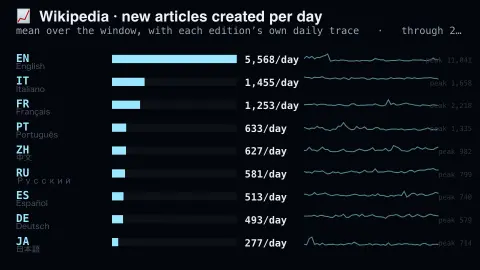
The Which Wikipedia Is Growing screensaver shows new articles created per day across the nine largest Wikipedia editions, gathered by the pipeline. Each row carries its own trace, so the spikes — usually bot-assisted imports of a few thousand villages at once — read as spikes. It's free, runs in your browser, and ESC exits.
Live preview
Press ESC to leave fullscreen. Settings are saved in your browser only.
How the Which Wikipedia Is Growing screensaver works
The saver reads the source described above and draws it on a canvas — no account, no tracking.
New articles created per day across the nine largest Wikipedia editions, gathered by the pipeline. Each row carries its own trace, so the spikes — usually bot-assisted imports of a few thousand villages at once — read as spikes.
It refreshes on a schedule, so what you see stays current.
Colours and any options can be changed in settings; nothing is stored beyond your own browser.
Reading article-creation traces
The Wikimedia Analytics API publishes statistics about the projects, including a count of new pages in its edited-pages group. This saver takes the daily count for nine Wikipedia editions and draws a short trace for each, so the shape of each line matters more than any single figure. The documentation says data from these endpoints does not include edits on redirects.
Edition size is not the same as growth. Cebuano and Swedish Wikipedia gained huge numbers of short articles from Lsjbot, a bot that primarily created articles about living organisms and geographical entities such as rivers, dams and mountains. It had written 2.7 million articles by 2014 at about 10,000 a day, and 9.5 million by January 2019. A sharp spike in a trace is plausibly the same kind of event, a batch creation, rather than a sudden wave of human editors.
The metric tallies creation, not quality: a stub counts as much as a long article, and pages deleted soon after creation may not stay in the total. Counts can include pages made by automated accounts unless the data is filtered by editor type. Treat it as a measure of editing activity, not of encyclopedic coverage.
A worked example
New articles created per day across the nine largest Wikipedia editions, gathered by the pipeline. Each row carries its own trace, so the spikes — usually bot-assisted imports of a few thousand villages at once — read as spikes.
Settings & tips
- Accent and Background recolour the display.
- Every value on screen comes from the live source — nothing is simulated.
- Press ESC to leave fullscreen.
Frequently asked questions
- Is this real data?
- Yes — it comes from the source named on this page and is refreshed on a schedule.
- Is a key needed?
- No. This source is fully key-less.
- Is it free?
- Yes, and it runs entirely in your browser.
- Why are there sudden spikes?
- They are often bulk creations by bots or scripted imports. Lsjbot, for example, created millions of short articles about places and species on several Wikipedias.
- Does more new pages mean a better Wikipedia?
- Not necessarily. The metric counts creations, regardless of length, quality or later deletion.