How Many Read Wikipedia Screensaver
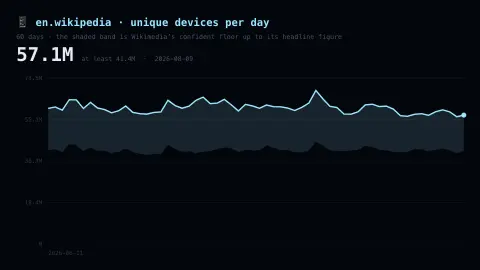
The How Many Read Wikipedia screensaver shows unique devices reading Wikipedia each day, from the Wikimedia Analytics API and key-less. Drawn as a band rather than a line because Wikimedia publishes a confident floor and a headline figure, and the truth is between them. It's free, runs in your browser, and ESC exits.
Live preview
Press ESC to leave fullscreen. Settings are saved in your browser only.
How the How Many Read Wikipedia screensaver works
The saver reads the source described above and draws it on a canvas — no account, no tracking.
Unique devices reading Wikipedia each day, from the Wikimedia Analytics API and key-less. Drawn as a band rather than a line because Wikimedia publishes a confident floor and a headline figure, and the truth is between them.
It refreshes on a schedule, so what you see stays current.
Colours and any options can be changed in settings; nothing is stored beyond your own browser.
Counting devices without tracking people
Wikimedia publishes traffic statistics through its open Analytics API. One measure is unique devices, counted per domain, such as en.wikipedia.org, with daily and monthly tables and an access-site split of all sites, desktop and mobile.
Wikimedia counts without building user profiles. A Last-Access cookie stores only the year, month and day of a device's previous visit. The underestimate counts devices that reached a host at least twice, as shown by that cookie. The offset adds single-action sessions without cookies, identified by a hash of IP address, user agent and accept-language that appears only once in the period. The estimate is the underestimate plus the offset. The offset can err in both directions: it undercounts fresh mobile sessions behind shared carrier addresses and overcounts devices whose IP changes or whose cookies are often deleted.
A device is not a person. One reader may use several devices, and a shared computer merges many people into one. The method misses people who refuse cookies, and because only requests carrying some cookie are counted, many bots are filtered, though unlabeled bots can still get through. Wikimedia also documents data issues, such as a change in the webrequest source on 1 April 2025.
A worked example
Unique devices reading Wikipedia each day, from the Wikimedia Analytics API and key-less. Drawn as a band rather than a line because Wikimedia publishes a confident floor and a headline figure, and the truth is between them.
Settings & tips
- Edition changes what the saver shows.
- Accent and Background recolour the display.
- Every value on screen comes from the live source — nothing is simulated.
- Press ESC to leave fullscreen.
Frequently asked questions
- Is this real data?
- Yes — it comes from the source named on this page and is refreshed on a schedule.
- Is a key needed?
- No. This source is fully key-less.
- Is it free?
- Yes, and it runs entirely in your browser.
- Why is there a band instead of one line?
- Wikimedia publishes an underestimate, a conservative count of devices seen before, and an estimate that adds an offset for cookieless single-visit traffic. The band spans the two.
- Does a dip in the band mean fewer people read Wikipedia?
- Not necessarily. The method has documented biases, and changes in cookie behaviour or network addressing can shift the counts without a change in actual readers.