Vortex Field Screensaver
Vortex Field is a free, in-browser screensaver where seven to twelve point vortices each spin the particles around them, faster near the core and slower far away, the way a real vortex does. Their spins point both ways, their cores drift on slow loops, and the sum of all of them is a garden of eddies that never settles. Nothing to download, and ESC exits at any time.
Live preview
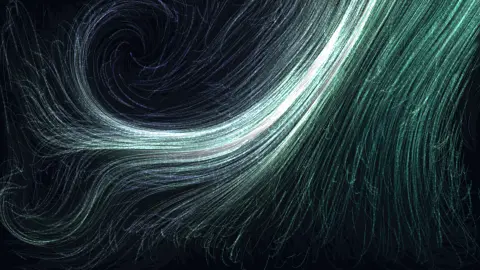
Press ESC to leave fullscreen. Settings are saved in your browser only.
How the Vortex Field screensaver works
A point vortex is the simplest model of a whirlpool: the fluid moves tangentially around a centre at a speed that falls off as one over the distance. Right at the centre that would be infinite, so each core is softened with a small constant that keeps the speed finite and the innermost particles from flying apart.
The saver seeds between seven and twelve of them at random positions, with random strengths and random spins — some clockwise, some counter. At every point the velocity is the vector sum of all the vortices’ contributions, which is why two neighbouring vortices spinning the same way create a fast channel between them and two opposing ones create a still zone.
Each core does not sit still: it circles its home position on a small loop whose radius and phase are also seeded. The Evolve slider sets how fast those loops turn, so the whole pattern breathes rather than freezing into a fixed diagram.
Particles accelerate toward the local direction with damping and stroke a segment per frame. The seed fixes the vortex layout, so typing the same seed in again brings back the same garden.
Point vortices from Helmholtz to Onsager
The point vortex is a classical idealisation in fluid dynamics: an infinitely thin whirl whose surrounding flow circulates with speed inversely proportional to distance. Hermann von Helmholtz worked out the equations of vortex motion in the 1850s, showing that in an ideal fluid each vortex is carried along by the flow produced by all the others. That means a handful of vortices set each other moving in an intricate dance, even though each one individually only spins.
Several well-known behaviours come out of this. Two vortices of the same sign circle each other, and two of opposite sign move off together as a pair in a straight line. Three vortices still move regularly, but four or more can already behave chaotically. Lars Onsager, in 1949, used point vortices to explain why two-dimensional turbulence tends to gather into large coherent swirls instead of fine-grained mixing.
Real fluids have viscosity, so a true vortex core is not a singularity, and on screen the same smoothing is applied for a practical reason. Here the particles are tracers, like dye, riding on the field rather than affecting it. What you see is a streak pattern of flow that has been sampled, not a measured fluid.
A worked example
At the defaults — Aurora, 2200 particles, Trail 62, Evolve 1 — nine or so eddies fill the frame, each a spiral of teal and violet with a quiet eye at its centre, drifting slowly against one another. Set Evolve to 0 and the eddies lock into a still diagram; raise Speed to 2 and the spirals tighten into rapid whirlpools.
Settings & tips
- Reseed a few times: the number, spin and spacing of the vortices change the whole composition.
- Blend in Simplex drift at 30% to add slow background currents between the eddies.
- Trail 100 with a few hundred particles draws a clean, static diagram of the streamlines.
Frequently asked questions
- What is a point vortex?
- An idealised whirlpool concentrated at a single point. Fluid circulates around it at a speed proportional to one over the distance, and the flow from several of them adds together. It is a classic model in fluid dynamics and here each core is softened so the speed stays finite.
- Is the Vortex Field screensaver free?
- Yes. It runs free in your browser with nothing to download or install, and it works offline once the page has loaded.
- What does the Seed setting do?
- Everything is deterministic from the seed: the noise table, where the field’s features land and the order particles spawn in. Leave it blank for a fresh random layout on every run, or type any short word or number to get the same layout back each time.
- Why does the image ripple when I move the mouse?
- The cursor and a lagging echo of it act as two wave sources. Their interference pattern nudges nearby particles onto the bright fringes and dims the dark ones, so the flow visibly reacts to you. Turn off Cursor ripples in the settings if you want the field left alone.
- How do I exit the Vortex Field screensaver?
- Press the ESC key at any time to leave fullscreen and return to the page.
- Do the vortices themselves move in a real fluid?
- Yes. In an ideal fluid each vortex is carried along by the flow induced by all the others, which is what makes vortex systems dance; the particles here only trace the flow.
- Why do opposite-signed vortices form fast streams?
- Between a clockwise and a counterclockwise whirl the flows point the same way, creating a jet between them. Such a pair moves along together, like the cross-section of a smoke ring.
- Is this how real hurricanes behave?
- Not directly. Point vortices model idealised two-dimensional flow, and real storms involve rotation, heat and three-dimensional effects, though the vortex picture is a useful teaching tool.