Driftfield Studio Screensaver
Driftfield Studio is a free, in-browser generative art screensaver. Thousands of particles drift through one of fourteen flow fields — simplex and curl noise, vortices, potential flow, magnetic dipoles, a black hole, a star system, the Lorenz attractor and more — and leave ink behind in one of ten palettes. Fifteen curated presets give you a good frame instantly; every control is yours after that. Nothing to download, and ESC exits at any time.
Live preview
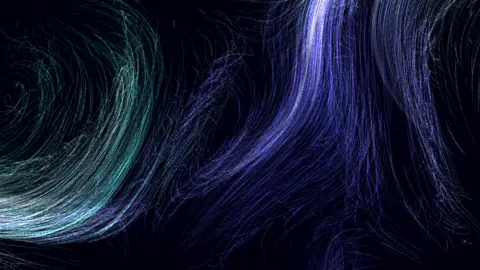
Press ESC to leave fullscreen. Settings are saved in your browser only.
How the Driftfield Studio screensaver works
Every field boils down to the same thing: at any point on screen it answers which way should a particle here go. The noise fields answer with 3D simplex noise read as an angle, curl, warped or layered in octaves. The physics fields answer with real equations — potential flow past a cylinder, the dipole field, inverse-square gravity, a Keplerian accretion flow. Two fields position their particles directly instead: the Lorenz system integrated per particle, and the de Jong map iterated as points.
Each frame, every particle reads the direction beneath it, accelerates toward it with damping, and draws a short segment from where it was to where it is. Segments are bucketed by colour and stroke width and stroked as batched paths, which is what lets four thousand particles run at full frame rate. The previous frame is faded toward the background in banked steps rather than every frame, because at the tiny alphas long trails need an 8-bit channel would otherwise round straight back and the fade would stall.
Blend lerps a second field’s direction into the first. It is deliberately a plain lerp and not a renormalise, because several fields vary their magnitude on purpose — a black hole speeds up near the horizon, orbital charges really accelerate into a well — and that variation is worth carrying through. Both fields stay seeded, both get their per-frame tick, and both get to consume particles, so blending a black hole into anything still eats what crosses the horizon.
Colour is assigned from a very low-frequency noise field at spawn time, so neighbouring particles share a hue and the picture bands into painted regions instead of confetti. A preset applies a field, palette, seed and every slider at once; they were each picked from a render, not guessed, and exist because a random roll lands on a dull frame often enough to be worth a curated floor.
Flow fields, simplex noise and generative painting
A flow field assigns a direction to every point in a plane, and a particle placed in it follows the arrows. The idea comes from fluid dynamics, where a velocity field describes how a liquid or gas moves, and from the study of dynamical systems. In generative art it is a common way to produce silky, painterly line work: thousands of particles each leave a short trail, and the trails bunch into currents.
Noise is the usual source of fields that look natural. Simplex noise, designed by Ken Perlin in 2001 to address the limits of his earlier Perlin noise, gives smooth pseudo-random values that vary gradually from place to place, with less directional bias and lower cost in higher dimensions. Read as an angle, it yields a flowing field with no sharp changes. Curl noise, described by Bridson, Hourihan and Nordenstam in 2007, derives a velocity from the curl of a noise field, which makes the flow incompressible: particles circulate like eddies in water instead of piling up or draining away.
Fields drawn from physics have their own character. The Lorenz system, found by meteorologist Edward Lorenz in 1963 as a simplified model of atmospheric convection, never settles down for the classic parameter values, and its attractor is often said to resemble a butterfly. The de Jong map is an iterated formula that places points directly rather than steering them. Blending fields mixes these characters into something neither would produce alone.
A worked example
Pick the Event horizon preset. That sets the field to Black hole, the palette to Ultraviolet, 2600 particles, Trail 62 and the seed abcd, so the hole lands at the same spot every time. Particles spiral inward, brighten as they speed up near the horizon, and vanish into a clean dark disc. Switch the preset to Warped horizon and the same scene gains a 45% blend of Domain warp: the accretion flow keeps its pull but the streams fold and marble on the way in. Set the preset back to Custom and the sliders below take over again.
Settings & tips
- Trail at 100 never fades: the canvas becomes a cumulative painting, which suits the point-based de Jong field and the Lorenz butterfly best.
- Evolve at 0 freezes the field so the streams settle into fixed channels; raise it past 2 for restless, churning motion.
- Blend a noise field into a physics one at 30–50% — Curl into Dipoles, Domain warp into Black hole — for structure that still breathes.
Frequently asked questions
- What is a flow field?
- A flow field assigns a direction to every point in space. Particles read the direction under them and step that way each frame, so a smooth field turns into long streamlines and a turbulent one into eddies. Driftfield offers fourteen different ways of generating that field.
- Which fields can be blended?
- Any field that exposes a direction: all of them except the Lorenz attractor and the de Jong map, which position their particles directly and have no direction to mix. The Blend control is ignored while one of those two is the main field.
- What does the Seed setting do?
- Everything is deterministic from the seed: the noise table, where the field’s features land and the order particles spawn in. Leave it blank for a fresh random layout on every run, or type any short word or number to get the same layout back each time.
- Why does choosing a preset make the other controls stop responding?
- A preset is a complete recipe — field, palette, seed and every slider — and it overrides the controls below it so that the label always describes what you are looking at. Set the preset back to Custom to hand control back to the individual settings.
- How do I exit the Driftfield Studio screensaver?
- Press the ESC key at any time to leave fullscreen and return to the page.
- What is curl noise?
- It derives a flow from the curl of a noise field, so the resulting vectors are divergence-free, with no sources or sinks. Particles swirl around like eddies instead of clumping.
- Where does the Lorenz system come from?
- Edward Lorenz developed it in 1963 as a simplified model of atmospheric convection. For the classic parameters its solutions never settle down or repeat, tracing the well-known butterfly-shaped attractor.