Star System Screensaver
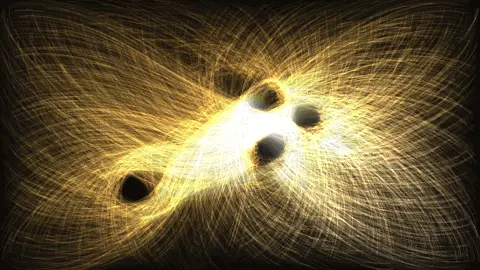
Star System is a free, in-browser screensaver where thousands of particles orbit three to five stars under Newtonian gravity. Some stars are fixed; the others circle the barycentre and drag their gravity wells with them, combing the particles into tidal streams and spiral arms. Particles launch on near-circular orbits with almost no damping, so orbits really survive, and any that reach a star are consumed and reborn elsewhere. Nothing to download, and ESC exits at any time.
Live preview
Press ESC to leave fullscreen. Settings are saved in your browser only.
How the Star System screensaver works
Each star pulls with an inverse-square force proportional to its mass, and the field at any point is the vector sum over all the stars. Unlike the noise fields this one keeps the force magnitude, so particles accelerate as they fall inward and slow as they climb out.
The default particle dynamics in Driftfield are heavily damped to stop noise fields running away, and that damping flattens every orbit into a straight plunge. This field overrides the damping to nearly zero and raises the speed cap, which is what lets a launched particle complete orbit after orbit.
A particle spawned at rest would just fall into the nearest star, so each one is launched tangentially at roughly the circular-orbit speed for the star nearest it, in a random direction of travel. Reaching a star consumes the particle; without that, every core would pile into a saturated blob.
Stars that are not fixed move on ellipses around the centre at a rate set by Evolve. As a well moves, the particles orbiting it are stretched into tidal tails and wound into spiral arms, the same way interacting galaxies are. Set Evolve to 0 and the system becomes a fixed set of nested orbits.
The gravitational many-body problem
Newton’s law of gravitation says that every mass attracts every other, with a force falling off as the square of the distance. For two bodies the resulting orbits are solved exactly and are the ellipses, parabolas and hyperbolas known since Kepler. For three bodies there is no general closed-form solution, a challenge known as the three-body problem. Henri Poincaré’s work in the late nineteenth century showed that such systems cannot be solved exactly in general, and most starting conditions give chaotic motion.
For many stars the usual approach is numerical. Astronomers simulate star clusters and galaxies by calculating the pull on each particle and stepping forward in time. Tidal streams are long bands of stars orbiting a galaxy, usually pulled out of a globular cluster or dwarf galaxy by the tidal forces of the larger host. Because they are sensitive to the host’s gravity, they help astronomers study how mass is distributed in the Milky Way.
What you see is a toy version. Real galaxies contain billions of stars and large amounts of dark matter, and stars rarely collide because space is mostly empty. The particles here behave as test masses moving in the field of a few heavy stars, which is why they trace orbits and swirls rather than clumping together.
A worked example
At the defaults — Sandstorm palette, 2600 particles, Trail 62, Evolve 1 — gold and cream particles circle four bright cores, and as two of the cores drift past each other the rings between them stretch into long bridges and tails. Blend in Shear billows at 40% with seed 77x2 for the studio’s Billowing stars look, where the orbits ripple as if seen through moving air.
Settings & tips
- Evolve 0 gives clean nested orbits; Evolve 2 makes the wells sweep through each other constantly.
- Trail 100 draws the orbits as permanent rings and the tidal tails as a record of every encounter.
- Reseed to change how many stars are fixed and how heavy each one is.
Frequently asked questions
- Why do the orbits survive here but not in the other fields?
- Because this field switches off most of the damping. The other Driftfield fields slow particles every frame so noise cannot run away with them, and that friction would turn any orbit into a spiral fall. Here damping is almost zero and the speed cap is raised, so a launched particle keeps its orbital energy.
- Is the Star System screensaver free?
- Yes. It runs free in your browser with nothing to download or install, and it works offline once the page has loaded.
- What does the Seed setting do?
- Everything is deterministic from the seed: the noise table, where the field’s features land and the order particles spawn in. Leave it blank for a fresh random layout on every run, or type any short word or number to get the same layout back each time.
- Why does the image ripple when I move the mouse?
- The cursor and a lagging echo of it act as two wave sources. Their interference pattern nudges nearby particles onto the bright fringes and dims the dark ones, so the flow visibly reacts to you. Turn off Cursor ripples in the settings if you want the field left alone.
- How do I exit the Star System screensaver?
- Press the ESC key at any time to leave fullscreen and return to the page.
- What is a tidal stream?
- A long band of stars orbiting a galaxy, usually drawn out of a small galaxy or globular cluster by the tidal forces of a larger host.
- Why is the three-body problem hard?
- Three mutually attracting bodies have no general closed-form solution, and their motion is chaotic for most starting conditions, so numerical simulation is the practical method.
- Do stars in a galaxy collide often?
- Very rarely. The distances between stars are enormous compared with their sizes, so close encounters are uncommon.