Shear Billows Screensaver
Shear Billows is a free, in-browser screensaver built on the Kelvin–Helmholtz instability: the thing that rolls the boundary between two winds into a row of breaking waves, in clouds, in the ocean, and on Jupiter. Stacked layers flow in alternating directions, each carrying the textbook sech² perturbation across its boundary, and the particles riding them roll the boundaries up into cat’s-eye billows. Nothing to download, and ESC exits at any time.
Live preview
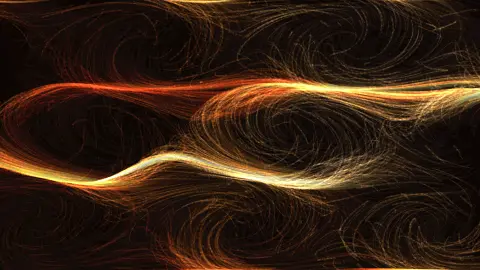
Press ESC to leave fullscreen. Settings are saved in your browser only.
How the Shear Billows screensaver works
Cut the screen into three to five horizontal bands and send each one flowing the opposite way to its neighbours. Across each boundary the velocity changes smoothly from one direction to the other following a hyperbolic tangent, which is the standard shear-layer profile.
A shear layer is unstable. Linear theory says the fastest-growing disturbance has a cross-stream shape of sech² — a bump centred on the boundary that vanishes into either stream — multiplied by a sine wave along the flow. The saver adds exactly that mode, with a seeded wavelength and phase, and lets it travel along the band.
Particles being advected through that perturbed shear do what real fluid parcels do: the ones just above the boundary are pushed down into the opposing stream and dragged back, the ones below are pushed up, and the boundary rolls into a row of closed cat’s-eye vortices.
The perturbation travels at a rate set by Evolve, so the billows march along their bands and re-form continuously. There is no noise in this field, so Detail is only relevant if one of the noise fields is blended in.
Kelvin-Helmholtz billows in nature
When two layers of fluid slide past each other at different speeds, the boundary between them can become unstable. A small ripple grows and curls over into a row of vortices. Hermann von Helmholtz discovered the instability in 1868, and Lord Kelvin (William Thomson) later developed a mathematical solution for its linear stage in 1871, which is why it carries both names.
It shows up on many scales: in cloud layers on Earth, in the atmosphere of Jupiter, in the Sun’s atmosphere, and as billows in the deep ocean. Whether it develops depends on a balance between shear and density layering, expressed by the Richardson number. Density layering stabilises the interface, and the layer is typically unstable when the Richardson number falls below about 0.25.
Seen from the side, each roll has closed streamlines at its centre in a cat’s-eye pattern. The system here is not a full fluid simulation: it applies the leading theoretical disturbance and watches how particles move through it, which captures the shape of the early stage and not the chaotic breakdown that follows in real flows.
A worked example
At the defaults — Ember palette, 2400 particles, Trail 62, Evolve 1 — four orange bands slide past each other and their boundaries curl into rows of glowing breaking waves, like the billow clouds seen on a windy morning. Set Evolve to 0.3 and the waves crawl; raise Speed to 2 and they tumble over like surf.
Settings & tips
- Reseed to change the number of bands and the wavelength of the billows.
- Blend Shear billows into the Star system at 40% for the studio’s Billowing stars preset.
- Cyanotype makes it look like a satellite image of ocean eddies; Sandstorm like Jupiter’s cloud bands.
Frequently asked questions
- What is the Kelvin–Helmholtz instability?
- The instability of a boundary between two fluids moving at different speeds. Small ripples on the boundary grow and roll over into a row of vortices. It produces the wave-shaped billow clouds in the sky, wind waves on water, and the turbulent bands on Jupiter and Saturn.
- Is the Shear Billows screensaver free?
- Yes. It runs free in your browser with nothing to download or install, and it works offline once the page has loaded.
- What does the Seed setting do?
- Everything is deterministic from the seed: the noise table, where the field’s features land and the order particles spawn in. Leave it blank for a fresh random layout on every run, or type any short word or number to get the same layout back each time.
- Why does the image ripple when I move the mouse?
- The cursor and a lagging echo of it act as two wave sources. Their interference pattern nudges nearby particles onto the bright fringes and dims the dark ones, so the flow visibly reacts to you. Turn off Cursor ripples in the settings if you want the field left alone.
- How do I exit the Shear Billows screensaver?
- Press the ESC key at any time to leave fullscreen and return to the page.
- Where can I see Kelvin-Helmholtz clouds?
- Look for evenly spaced, wave-crest shapes in thin cloud layers, which form where air above a layer moves much faster than air below it. The instability is common in cloud layers.
- What is the Richardson number?
- It compares the stabilising effect of density layering with the destabilising effect of shear. A shear layer is typically unstable when the number falls below about 0.25.
- Who are Kelvin and Helmholtz?
- Hermann von Helmholtz discovered the instability in 1868, and William Thomson, later Lord Kelvin, developed a mathematical solution for the linear instability in 1871.