Void-of-Course Moon Timer Screensaver
The Void-of-Course Moon Timer screensaver tracks the Moon's real void-of-course windows. It is free, runs in your browser, and ESC exits.
Live preview
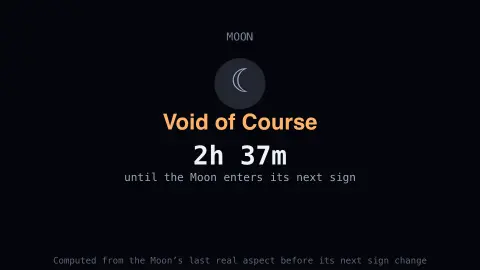
Press ESC to leave fullscreen. Settings are saved in your browser only.
How the Void-of-Course Moon Timer screensaver works
The saver computes the Moon's real position and its next real sign change.
It scans forward for the Moon's last real major aspect before that change.
If that last aspect has already passed, the Moon is void of course now.
Everything is computed locally — no network, no key.
The void-of-course Moon in traditional astrology
In Western astrology the Moon is called void of course when, in the sign it currently occupies, it has finished its last major aspect and will make no further one before moving into the next sign. The major (Ptolemaic) aspects are the conjunction, sextile, square, trine and opposition, at 0, 60, 90, 120 and 180 degrees between two bodies. Astrologers read the gap as a time when the Moon has nothing further to apply to.
The idea is old. William Lilly's Christian Astrology, published in 1647, describes a planet as void of course when it has separated from one planet and, during its stay in that sign, does not apply to another, and notes that this is most commonly said of the Moon. Modern practice usually restates this as the Moon's last aspect before leaving the sign, and authors disagree about details such as which aspects and orbs count, so two almanacs can print different void windows. The Moon covers roughly 13 degrees a day, so it spends a couple of days in each sign.
This is a cultural practice, not a scientific finding. It is used mainly in horary and electional astrology, and there is no evidence that void-of-course periods affect outcomes. The Moon's position and the angles it makes are real astronomy; the meaning assigned to them is interpretation.
A worked example
Once the Moon's real last aspect to another planet has completed, it drifts void of course until it real-ly enters the next sign.
Settings & tips
- Void-of-course is a classical concept for a Moon making no new aspects.
- Accent recolours the timer and status readout.
- The window ends the real moment the Moon enters its next sign.
Frequently asked questions
- What does void-of-course mean?
- The real classical window after the Moon's last major aspect before it changes sign.
- How long do these windows last?
- It varies — from real minutes to over a day, depending on the Moon's aspect pattern.
- Is a key needed?
- No. Everything is computed locally in your browser.
- Is it free?
- Yes — free, no download, in your browser.
- Do all astrologers use the same rules?
- No. Sources differ on which aspects and which orbs count, and on whether the period is measured to the sign boundary or by another rule, so void times can differ between almanacs.
- What ends a void-of-course period?
- In the modern sign-based definition, the period ends when the Moon crosses into the next zodiac sign.
- Is there any evidence that it matters?
- No. It is an astrological tradition, and the saver only computes the Moon's position and the angles it makes.