Retrograde Season Calendar Screensaver
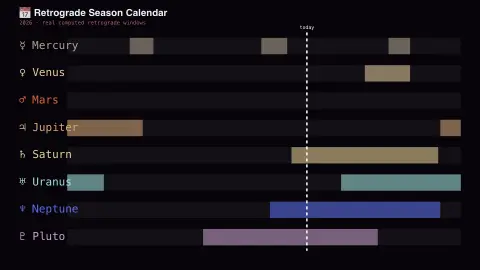
The Retrograde Season Calendar screensaver maps every real retrograde window this year. It is free, runs in your browser, and ESC exits.
Live preview
Press ESC to leave fullscreen. Settings are saved in your browser only.
How the Retrograde Season Calendar screensaver works
The saver computes each planet's real ecliptic longitude across the year.
Stretches where that real longitude moves backward are marked retrograde.
Each planet gets its own row on a real January-to-December timeline.
Everything is computed locally — no network, no key.
Retrograde motion, the optical illusion
A planet in retrograde appears to reverse course against the background stars for a while, then resume its usual eastward drift. Nothing physical reverses. We watch the other planets from a moving platform, Earth. When Earth overtakes a slower outer planet on the inside track, that planet seems to drift backwards, like a slower car you pass on the motorway. Mercury and Venus show the effect as they pass between us and the Sun.
Apollonius explained the loops with deferents and epicycles, and Ptolemy used that scheme. Copernicus and later astronomers understood retrograde motion as an illusion caused by Earth’s own movement. Retrograde stretches are centred on opposition, when the planet is opposite the Sun and at its brightest of the year.
The calendar marks the stretches where each planet’s ecliptic longitude decreases. Typical durations are about 22 days for Mercury, 41 for Venus, 72 for Mars, 121 for Jupiter, 138 for Saturn, 151 for Uranus and 158 for Neptune. The astronomy is verifiable geometry; any meaning attached to it belongs to astrology and is a matter of belief.
A worked example
A real retrograde stretch shows up as a shaded band on a planet's row, with today's real date marked on the timeline.
Settings & tips
- Outer planets retrograde for real months; inner planets for real weeks.
- Accent recolours the retrograde bands.
- Today's real date is marked with a vertical line on the timeline.
Frequently asked questions
- Is this list computed or published?
- Computed fresh from real orbital motion each time, not copied from a published almanac.
- Which planets are shown?
- Mercury through Pluto — the real planets besides Earth that show retrograde motion from here.
- Is a key needed?
- No. Everything is computed locally in your browser.
- Is it free?
- Yes — free, no download, in your browser.
- Why does Mercury go retrograde so often?
- Mercury has the shortest orbit of any planet, so Earth and Mercury line up for a retrograde loop more often than for any other planet. Its retrograde stretches are also the shortest, about three weeks.
- Does a planet slow down or stop during retrograde?
- Its apparent motion slows to a halt at the start and end of each retrograde stretch, called stationary points, because it switches direction against the stars. Its real orbital speed does not change.
- Is retrograde motion visible to the naked eye?
- Yes, over weeks. A bright planet such as Mars or Jupiter traces a slow loop against the stars if you track its position night by night.