Tsunami Warning Board Screensaver
The Tsunami Warning Board screensaver shows real active US tsunami alerts. It is free, runs in your browser, and ESC exits.
Live preview
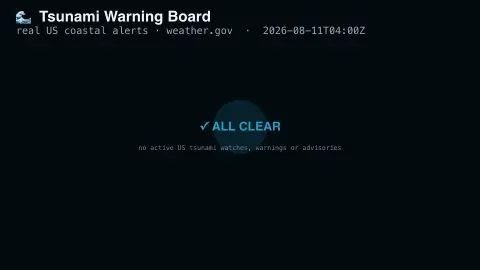
Press ESC to leave fullscreen. Settings are saved in your browser only.
How the Tsunami Warning Board screensaver works
The saver reads real active alerts from the National Weather Service API.
Each entry shows a real event type, affected area and time sent.
The board shows an all-clear state when no real alert is active.
No key is required for this key-less public endpoint.
How US tsunami alerts are issued
Tsunami messages for the United States come from two NOAA centres: the National Tsunami Warning Center in Palmer, Alaska, and the Pacific Tsunami Warning Center. They prepare and disseminate tsunami warning, advisory, watch and information products, which reach the public through National Weather Service channels as alerts.
The vocabulary has four levels. A Warning is the highest: a tsunami that could cause widespread inundation is imminent, expected or under way. An Advisory means strong currents are the main concern, so people should stay away from the shore. A Watch is an early alert for areas that may be affected by a distant event, and it is later upgraded to a warning or advisory, or cancelled. An Information Statement means minor waves at most, with no action suggested.
An empty board is the normal state, because genuine warnings are rare. This display is a monitoring curiosity and carries no safety guarantee. In an emergency, rely on official local alerts, sirens and instructions from emergency services.
A worked example
When a real coastal tsunami advisory is active, its real headline and affected area appear on the board.
Settings & tips
- Event types and areas are real, unedited National Weather Service alerts.
- Accent recolours the board and header text.
- Tsunami alerts are genuinely rare, so an all-clear state is normal.
Frequently asked questions
- Is this real alert data?
- Yes — real active alerts from the National Weather Service's own API.
- Is a key needed?
- No. The alerts API is fully key-less.
- Why is it often empty?
- Because real tsunami warnings are rare — that is a genuine all-clear.
- Is it free?
- Yes — free, no download, in your browser.
- What is the difference between a watch and a warning?
- A watch is an early alert for areas that may be affected by a distant event, issued while the threat is still being assessed. A warning means a tsunami that could cause widespread inundation is imminent, expected or under way.
- Does it cover tsunamis outside the United States?
- The feed relies on US National Weather Service alerts, so it focuses on US coasts and territories. Other countries have their own warning agencies.
- Does an earthquake always cause a tsunami?
- No. Mainly large earthquakes under or near the sea floor can produce one. Most earthquakes, including many strong ones, do not.