Volcano Alert Levels Screensaver
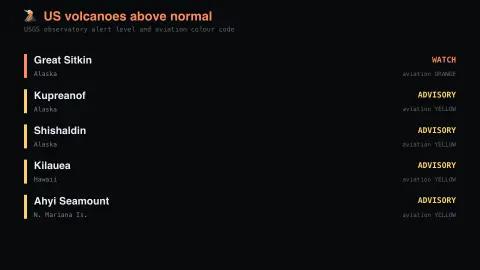
The Volcano Alert Levels screensaver shows the US volcanoes currently sitting above their normal background level, from the USGS observatories: the ground alert level and the aviation colour code that tells pilots whether ash is a risk. It's free, runs in your browser, and ESC exits.
Live preview
Press ESC to leave fullscreen. Settings are saved in your browser only.
How the Volcano Alert Levels screensaver works
The saver reads the USGS volcano observatories directly in your browser — no key and no account.
The US volcanoes currently sitting above their normal background level, from the USGS observatories: the ground alert level and the aviation colour code that tells pilots whether ash is a risk..
It refreshes on a schedule, so what you see stays current.
Colours can be changed in settings; nothing is stored beyond your own browser.
Two scales for volcano unrest: ground and sky
The US Geological Survey’s Volcano Hazards Program works through five observatories: the Alaska Volcano Observatory, the California Volcano Observatory, the Cascades Volcano Observatory, the Hawaiian Volcano Observatory and the Yellowstone Volcano Observatory. Each monitors, researches and issues formal notices of activity for volcanoes in its assigned region. Since 2006 they have shared one nationwide alert system.
That system has two parallel parts built on the same underlying conditions. The alert level (Normal, Advisory, Watch, Warning) describes the level of unrest and eruptive activity at the volcano. The aviation colour code (Green, Yellow, Orange, Red) focuses on hazards to flight, especially ash emissions. Because the two are tuned to different audiences, communities on the ground and pilots in the air, a volcano is given a level on each scale.
Each level comes with a written explanation from the observatory describing the observed activity and what it implies for hazards. An elevated level is a statement about what the monitoring shows, not a forecast. When activity declines, the level is lowered, and the volcano stays monitored for renewed increases. The USGS volcano pages carry the reasoning behind any change.
A worked example
The US volcanoes currently sitting above their normal background level, from the USGS observatories: the ground alert level and the aviation colour code that tells pilots whether ash is a risk.
Settings & tips
- Accent and Background recolour the display.
- Data comes straight from the USGS volcano observatories in your browser.
- Press ESC to leave fullscreen.
Frequently asked questions
- Is this real data?
- Yes — it comes from the USGS volcano observatories and is refreshed on a schedule.
- Is a key needed?
- No. This source is fully key-less.
- Is it free?
- Yes — free, no download, in your browser.
- Does an elevated alert level mean an eruption is coming?
- Not necessarily. Advisory means unrest is above background levels, and the level is lowered again if activity declines. Watch and Warning signal a higher chance of eruption or an eruption in progress.
- Why are there two different scales?
- The alert level describes unrest and eruptive activity, while the aviation colour code centres on ash and other hazards to aircraft. The USGS issues both for US volcanoes.
- Does this cover volcanoes outside the United States?
- No. The scales are the USGS system for US volcanoes, so eruptions elsewhere are tracked by other national agencies.