The Names Behind The Names Screensaver
The Names Behind The Names screensaver maps common species names onto their accepted scientific names, marking whether each classification is currently accepted or has been superseded. It runs in the browser with nothing to install; press ESC to exit.
Live preview
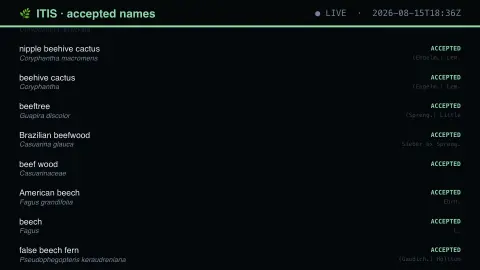
Press ESC to leave fullscreen. Settings are saved in your browser only.
How the The Names Behind The Names screensaver works
The saver reads ITIS, the US Integrated Taxonomic Information System, refreshed through this site's pipeline.
No account and no key: the request goes straight from your browser, or from this site's own refreshed copy of the feed where the source does not permit browser access.
Values are drawn on a canvas that resizes with the window, so it works on a laptop or a wall display.
If the source is unreachable the saver says so on screen rather than showing stale numbers as though they were current.
Taxonomic authorities and why species names change
ITIS, the Integrated Taxonomic Information System, began as an interagency group of US federal agencies. Its partners include NOAA, USGS, USDA, EPA, the Smithsonian, the National Park Service and the Fish and Wildlife Service, along with NatureServe, Agriculture and Agri-Food Canada and Mexico’s CONABIO. It covers terrestrial, marine and freshwater taxa from all kingdoms, with a focus on North American species. It also cooperates with Species 2000 each year to produce the Catalogue of Life.
Every scientific name in ITIS receives a Taxonomic Serial Number, or TSN, a unique identifier that carries no meaning in itself. Both accepted names and their synonyms get TSNs, and a synonym’s record points to the name that replaced it. ITIS words the status differently by kingdom: for plants, fungi and chromists a name is “accepted” or “not accepted”, while for animals, bacteria, archaea and protozoa it is “valid” or “invalid”.
Common names are slippery. The same word can refer to different species in different places, and one species can have many names, which is why a lookup keyed on the scientific name is needed. Taxonomy is revised continually, so a status reflects the database at the time of the request, and ITIS itself advises users to cross-check against other sources and the primary literature.
A worked example
Each row pairs a common name with its scientific name in italics, the naming authority, and a status badge — green for accepted, orange for a name that has been reclassified. The search term rotates daily, so the board covers a different corner of the tree of life each day.
Settings & tips
- Accent and Background recolour the display without changing the data.
- Add it to a Multi-view grid to watch it alongside other live savers.
- Press ESC at any time to leave fullscreen.
Frequently asked questions
- Why do common names need mapping?
- Because they are ambiguous. A robin is a different bird on each side of the Atlantic, and dozens of unrelated plants are called some kind of fern. Scientific names exist precisely to remove that ambiguity.
- What does a superseded name mean?
- That the taxon has been reclassified since the name was assigned — usually because genetic evidence revealed the older grouping was wrong. The record keeps the old name pointing at the current placement.
- Is this real data?
- Yes. It comes from ITIS, the US Integrated Taxonomic Information System, refreshed through this site's pipeline. Nothing is invented or simulated, and if the source cannot be reached the saver reports that instead of drawing something plausible.
- Does it cost anything or need an account?
- No. Every screensaver here is free, runs in the browser and needs no sign-up. This one uses a public API that requires no key.
- What is a TSN?
- A Taxonomic Serial Number, the unique identifier ITIS assigns to each scientific name. It carries no information in itself, so software can link records reliably.
- What do valid and accepted mean in ITIS?
- They mark the preferred name. ITIS uses accepted or not accepted for plants, fungi and chromists, and valid or invalid for animals, bacteria, archaea and protozoa. A name that is not preferred points to the name that replaced it.
- Can two databases disagree about a name?
- Yes. Taxonomists do not always agree, and different projects update at different speeds, so ITIS advises cross-checking against other sources and the primary literature.