Retraction Watch Feed Screensaver
The Retraction Watch Feed screensaver scrolls scientific papers as they're retracted, drawn from Retraction Watch's real, widely cited database of research integrity issues, refreshed by a background pipeline. It's free, runs in your browser, and ESC exits.
Live preview
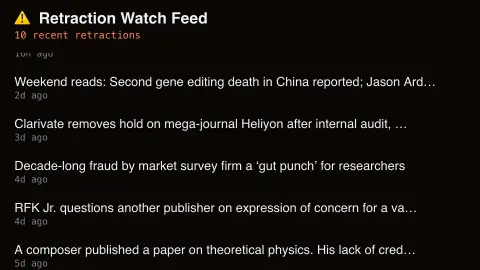
Press ESC to leave fullscreen. Settings are saved in your browser only.
How the Retraction Watch Feed screensaver works
A background pipeline reads Retraction Watch's real database of newly logged retractions.
Each entry scrolls through with the real paper title and its retraction reason where given.
A running count tracks retractions seen since the pipeline last refreshed.
Data refreshes on the pipeline's schedule, not live tick by tick.
Retractions, and the blog that tracks them
Retraction Watch is a project that reports on withdrawn scientific papers. It began as a blog in 2010, co-founded by Ivan Oransky and Adam Marcus, and the blog and database are run by The Center for Scientific Integrity, a non-profit. The Retraction Watch Database of retracted papers was acquired by Crossref, announced in September 2023, and made an open public resource, while Retraction Watch keeps maintaining its data under an agreement with Crossref.
A retraction is a journal's formal notice that a paper should not be relied on. The causes vary widely. Some involve misconduct such as fabricated data, image manipulation or plagiarism. Others come from honest mistakes, such as a contaminated sample or a coding error, and some from publisher problems like duplicate publication or compromised peer review. Notices differ in how much detail they give, which makes the reason hard to determine without reading them.
A retracted paper usually remains visible with a notice, and it is still cited sometimes. A headline here does not establish the full facts of a case, and no conclusion about individuals should be drawn from a single summary. The refresh depends on the pipeline schedule, so the newest events might not appear immediately.
A worked example
You might see a real retraction for data fabrication or duplicate publication scroll past — genuine entries from Retraction Watch's own database, not a dramatization.
Settings & tips
- Accent recolours the paper titles.
- Run
automation/run.py retractionwatchon your pipeline machine to refresh the data. - A retraction doesn't always mean misconduct — some are honest error corrections.
Frequently asked questions
- Is this a real database?
- Yes — Retraction Watch is a real, widely cited project maintained by science journalists since 2010.
- Why does it need a pipeline?
- Retraction Watch's database isn't reliably fetchable directly from a browser, so a small background script gathers it and saves a snapshot the saver loads.
- Does every retraction mean fraud?
- No — reasons range from honest errors to plagiarism to data fabrication; the feed shows the real reason where logged.
- Is it free?
- Yes — free, no download, in your browser.
- Does a retraction mean the authors committed fraud?
- Not necessarily. Retractions also result from honest errors and publisher problems, and the notice itself often says little, so the cause needs checking case by case.
- What happens to a retracted paper?
- It normally stays online marked as retracted, so the scholarly record is preserved. Some retracted papers continue to be cited, sometimes without acknowledging the retraction.
- Is the feed a complete list of retractions?
- It should not be treated as one. It shows entries from the Retraction Watch database as of the last pipeline refresh, and a recent notice may not have been logged yet.