Switzerland, Published Screensaver
The Switzerland, Published screensaver streams the Swiss federal open data catalogue in update order — some sixteen thousand datasets across four national languages, from the Confederation, the cantons and individual cities. It runs in the browser with nothing to install; press ESC to exit.
Live preview
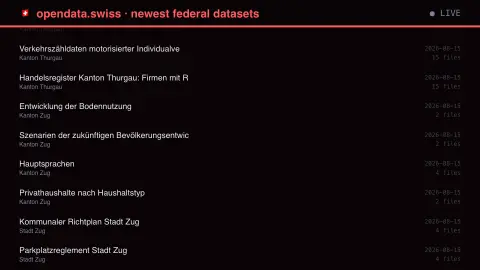
Press ESC to leave fullscreen. Settings are saved in your browser only.
How the Switzerland, Published screensaver works
The saver reads opendata.swiss, the Swiss federal open data portal.
No account and no key: the request goes straight from your browser, or from this site's own refreshed copy of the feed where the source does not permit browser access.
Values are drawn on a canvas that resizes with the window, so it works on a laptop or a wall display.
If the source is unreachable the saver says so on screen rather than showing stale numbers as though they were current.
Where Swiss public data lives
opendata.swiss is the Swiss public administration’s central portal for open government data. It is run by the OGD Office, part of the Federal Statistical Office, and it collects metadata from federal offices, cantons, communes and other public bodies, so a dataset you see may come from a national office or from a single city. The portal is a catalogue: the data itself is hosted by the providers, and the portal publishes a standardised description with a link to it.
Switzerland has four national languages, German, French, Italian and Romansh, and the catalogue is multilingual. Metadata must meet DCAT-AP CH, the Swiss application profile of the European DCAT-AP standard for describing open data catalogues, so entries carry a structured description of the dataset and its distributions. Geodata reaches the portal through geocat.ch, where its metadata is first entered and then transferred automatically.
Interpreting the stream: recently updated does not mean new. A series may be touched on a schedule with nothing to see in the numbers themselves. The size of the catalogue also reflects publishing habits, since a body that splits data into many small datasets will contribute more entries than one that posts a single large table.
A worked example
Each row names a dataset, the office that publishes it, when it changed and how many files it holds. Titles arrive as an object keyed by language — German, French, Italian, English — and choosing one is a small editorial act; this takes German where present because most of the catalogue is published in it, and falls back rather than showing a blank row.
Settings & tips
- Accent and Background recolour the display without changing the data.
- Add it to a Multi-view grid to watch it alongside other live savers.
- Press ESC at any time to leave fullscreen.
Frequently asked questions
- Why is the catalogue so large?
- Because Swiss federalism pushes publication down to the cantons and communes, so a country of nine million publishes more open datasets than several much larger neighbours.
- Which language does it show?
- German where a record has it, then French, Italian or English. The catalogue does not translate every record into every language, so the available title varies by publisher.
- Is this real data?
- Yes. It comes from opendata.swiss, the Swiss federal open data portal. Nothing is invented or simulated, and if the source cannot be reached the saver reports that instead of drawing something plausible.
- Does it cost anything or need an account?
- No. Every screensaver here is free, runs in the browser and needs no sign-up. This one uses a public API that requires no key.
- Is open data on opendata.swiss free to reuse?
- Each dataset states its own terms of use in its metadata, so check the terms on the dataset page before reusing it.
- Does the portal hold the data itself?
- Generally not. It is a metadata catalogue that points to files and services hosted by the publishing organisations.