What The World Is Coping With Screensaver
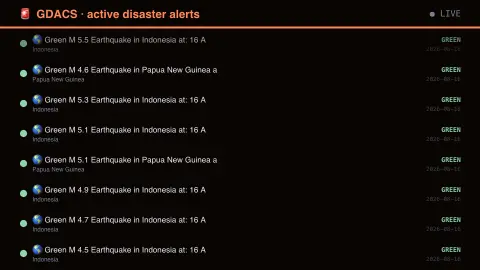
The What The World Is Coping With screensaver lists active disaster alerts worldwide — earthquakes, tropical cyclones, floods, volcanoes, droughts and wildfires — colour-coded green, orange or red by likely humanitarian impact. It runs in the browser with nothing to install; press ESC to exit.
Live preview
Press ESC to leave fullscreen. Settings are saved in your browser only.
How the What The World Is Coping With screensaver works
The saver reads GDACS, run jointly by the United Nations and the European Commission.
No account and no key: the request goes straight from your browser, or from this site's own refreshed copy of the feed where the source does not permit browser access.
Values are drawn on a canvas that resizes with the window, so it works on a laptop or a wall display.
If the source is unreachable the saver says so on screen rather than showing stale numbers as though they were current.
How GDACS rates a disaster
GDACS is the Global Disaster Alert and Coordination System, a cooperation framework set up in 2004 that brings together the United Nations, the European Commission and disaster managers worldwide. Its aim is better awareness, information sharing and coordination in the early phase of major sudden-onset disasters, when detailed field assessments do not yet exist.
The distinctive feature is its alert level, shown as green, orange or red. Levels come from automated impact models, one per hazard type, that use an event's location and strength to estimate the affected area, then weigh the population exposed and how vulnerable it is. So a strong earthquake far from any settlement can stay green, while a smaller one near a dense city may be rated higher. Earthquakes, tsunamis and tropical cyclones are assessed automatically, while floods and volcanic eruptions are entered manually.
Because the levels come from models, GDACS itself cautions that automatic notifications cannot always reliably predict the humanitarian impact of an event. Treat an alert level as a rough response-planning signal, not as a casualty count.
A worked example
Each row shows a coloured dot, the event and the country. The colour is the unusual part: GDACS grades by expected effect on people rather than by geophysical size, so a magnitude 6 earthquake under open ocean is green while a magnitude 5 beneath a dense city is not. Red events sort to the top regardless of age. Most days the list is almost entirely green earthquakes, which is itself worth seeing.
Settings & tips
- Accent and Background recolour the display without changing the data.
- Add it to a Multi-view grid to watch it alongside other live savers.
- Press ESC at any time to leave fullscreen.
Frequently asked questions
- What do the colours mean?
- Green is an event unlikely to need international assistance, orange is a possible need, and red indicates a likely humanitarian emergency. They are automated estimates from hazard size combined with population exposure and local vulnerability.
- Is every disaster here?
- No. GDACS covers specific hazard types detected by automated systems. Slow-onset events like famine, and conflict, are not in scope.
- Is this real data?
- Yes. It comes from GDACS, run jointly by the United Nations and the European Commission. Nothing is invented or simulated, and if the source cannot be reached the saver reports that instead of drawing something plausible.
- Does it cost anything or need an account?
- No. Every screensaver here is free, runs in the browser and needs no sign-up. This one uses a public API that requires no key.
- Is a red alert always the biggest disaster?
- Not necessarily. The level reflects estimated humanitarian impact, combining hazard strength with exposed population and vulnerability, so a moderate event in a densely populated, vulnerable region can outrank a more powerful one in empty country.
- Who runs GDACS?
- It is a cooperation framework between the United Nations, the European Commission and disaster managers worldwide, aimed at the early phase of major sudden-onset disasters.
- Are the alert levels measured or modelled?
- Modelled. Each hazard has its own impact model, and some alerts, such as floods and volcanic eruptions, are entered manually rather than computed automatically.