Swedish Power Zones Screensaver
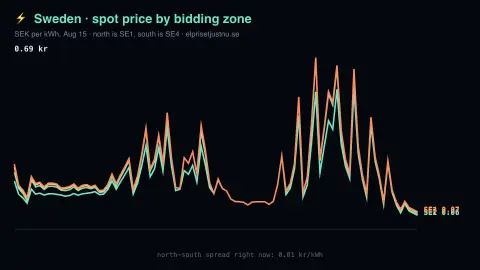
The Swedish Power Zones screensaver draws today's spot electricity price for all four Swedish bidding zones — SE1 and SE2 in the hydro-rich north, SE3 and SE4 in the populous south — in kronor per kilowatt-hour, live and key-less from Elprisetjustnu. The gap between the top and bottom lines is a direct readout of how congested the national grid is. It runs in the browser with nothing to install; press ESC to exit.
Live preview
Press ESC to leave fullscreen. Settings are saved in your browser only.
How the Swedish Power Zones screensaver works
The saver reads Elprisetjustnu, which publishes Nordic spot prices per zone per day.
No account and no key: the request goes straight from your browser, or from this site's own refreshed copy of the feed where the source does not allow browser access.
Values are drawn on a canvas that resizes with the window, so it works on a laptop or a wall display.
If the source is unreachable the saver says so on screen rather than showing stale numbers as though they were current.
Spot prices and Sweden's bidding zones
Nordic electricity is traded on a day-ahead market: prices for each delivery period of the next day are set in an auction, and the results are published shortly before 13:00 CET the day before. Every accepted bid in a zone is settled at the same clearing price for that period. Since 1 October 2025 the European day-ahead market has used 15-minute periods, so a day now has 96 prices per zone rather than 24 hourly ones.
Sweden has been divided into four bidding zones since 1 November 2011: SE1 (Luleå), SE2 (Sundsvall), SE3 (Stockholm) and SE4 (Malmö). Before that the country was a single price zone, and the grid operator Svenska kraftnät had to manage limits on transfers from north to south. When transmission lines between zones are full, the zones clear at different prices, so the gap between them is a signal of grid congestion.
The spot price shown here excludes VAT, taxes and surcharges, and a household bill adds network charges and the retailer's margin on top. Many customers are on fixed or averaged contracts and do not pay the hourly spot price directly. Prices are quoted in kronor per kilowatt-hour, converted from euros at a daily exchange rate.
A worked example
Four coloured lines run across the day, each labelled with its zone and current price. On an unconstrained day they sit almost on top of each other and the footer reads “all four zones clearing together”. On a cold, still afternoon SE4 climbs away from SE1 and the footer reports the spread — sometimes more than a krona per kilowatt-hour for the same electricity in the same country at the same moment.
Settings & tips
- Accent and Background recolour the display without changing the data.
- Add it to a Multi-view grid to watch it alongside other live savers.
- Press ESC at any time to leave fullscreen.
Frequently asked questions
- Why does one country have four prices?
- Because the transmission capacity between northern and southern Sweden is limited. Most generation is in the north and most demand is in the south, so when the link between them saturates the market splits and each zone clears at its own price.
- Which zone am I in?
- Stockholm is SE3 and Malmö is SE4; Sundsvall is SE2 and Luleå is SE1. The saver draws all four at once rather than asking, because the comparison between them is the interesting part.
- Is this real data?
- Yes. It comes from Elprisetjustnu, which publishes Nordic spot prices per zone per day. Nothing is invented or simulated, and if the source cannot be reached the saver reports that instead of drawing something plausible.
- Does it cost anything or need an account?
- No. Every screensaver here is free, runs in the browser and needs no sign-up. This one uses a public API that requires no key.
- Does the spot price equal what households pay?
- No. The spot price excludes VAT, taxes and surcharges. Bills add network charges and the retailer's margin, and many contracts are fixed or averaged rather than tied to spot prices.
- When are tomorrow's prices known?
- The day-ahead auction results are published around 12:55 CET, and price services typically show next-day prices from about 13:00, so tomorrow's prices are normally known by early afternoon.
- What causes prices to differ between zones?
- Limited transmission capacity. When the lines between zones are full, each zone clears at its own price instead of a shared one.