Finnish Power Prices Screensaver
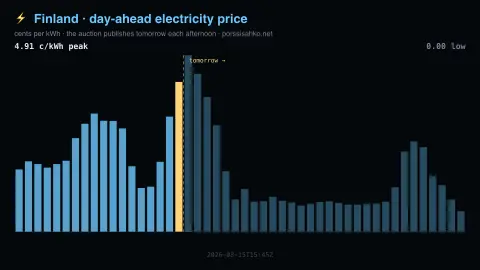
The Finnish Power Prices screensaver shows the day-ahead electricity price for Finland in cents per kilowatt-hour. Because the Nordic auction clears each afternoon for every hour of the following day, roughly half the chart is genuinely tomorrow — a published commitment rather than a forecast. A dashed rule marks where today ends. It runs in the browser with nothing to install; press ESC to exit.
Live preview
Press ESC to leave fullscreen. Settings are saved in your browser only.
How the Finnish Power Prices screensaver works
The saver reads Pörssisähkö's public price feed, refreshed through this site's pipeline.
No account and no key: the request goes straight from your browser, or from this site's own refreshed copy of the feed where the source does not allow browser access.
Values are drawn on a canvas that resizes with the window, so it works on a laptop or a wall display.
If the source is unreachable the saver says so on screen rather than showing stale numbers as though they were current.
A day-ahead market with tomorrow already priced
Finland belongs to the Nordic and Baltic wholesale electricity market, which is coupled with the wider European day-ahead market. In the day-ahead auction, producers and buyers submit offers for each trading period of the following day, and a clearing price is found for every period in each bidding area. The results are published in the afternoon, which is why a chart can show tomorrow’s prices as soon as the auction has closed.
Day-ahead prices have been set in 15-minute periods since the European day-ahead market moved from hourly to 15-minute market time units on 30 September 2025, so whether a feed shows quarter-hours or hourly figures depends on how it is aggregated. Prices are quoted here in cents per kilowatt-hour and reflect wholesale supply and demand in that period. Weather, wind output, hydropower, nuclear availability and flows over interconnectors to neighbouring areas all matter.
Households pay more than the wholesale figure because retail bills add margins, transmission fees and taxes, and many consumers are on fixed-price contracts that do not follow the market. The chart is most useful for people on spot-price contracts or for timing flexible consumption. Because future periods come from a completed auction they are settled prices, but real-time imbalances are handled separately.
A worked example
Bars run left to right across roughly two days. Everything left of the dashed gold rule has already happened; the gold bar is the hour running now; everything to the right is tomorrow, already fixed by the afternoon auction and drawn at lower opacity. Negative hours appear in blue below the zero line.
Settings & tips
- Accent and Background recolour the display without changing the data.
- Add it to a Multi-view grid to watch it alongside other live savers.
- Press ESC at any time to leave fullscreen.
Frequently asked questions
- Why does it show tomorrow?
- Because the day-ahead market really has already settled it. The auction clears in the early afternoon for all 24 hours of the following day, so from about two o'clock those prices are fixed and public. The saver marks them rather than presenting them as current.
- Are these retail prices?
- They are the spot price in cents per kilowatt-hour, which is directly comparable to a retail tariff but excludes transfer fees and tax. A spot-linked contract tracks this line; a fixed contract does not.
- Is this real data?
- Yes. It comes from Pörssisähkö's public price feed, refreshed through this site's pipeline. Nothing is invented or simulated, and if the source cannot be reached the saver reports that instead of drawing something plausible.
- Does it cost anything or need an account?
- No. Every screensaver here is free, runs in the browser and needs no sign-up. This one uses a public API that requires no key.
- Why can electricity prices be negative?
- When supply, for example from wind or solar, exceeds demand, the auction can clear below zero for some periods. Producers then pay to deliver power instead of earning for it.
- What is an interconnector?
- A high-voltage link between the grids of neighbouring areas. It lets power flow towards the higher-priced area, which tends to pull prices together.
- Are day-ahead prices still hourly?
- Not in the underlying auction. The European day-ahead market moved to 15-minute market time units on 30 September 2025, so hourly figures are often averages of four quarter-hours.