German Power Prices Screensaver
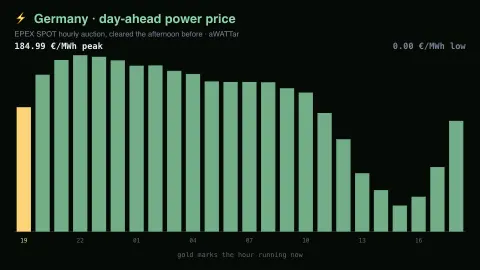
The German Power Prices screensaver plots the next 24 hours of German electricity prices from the day-ahead auction, in euros per megawatt-hour, read live from aWATTar with no key. Prices dip through the middle of the day when solar output peaks and spike into the evening. Negative hours — when generators pay to keep running — are drawn below the zero line rather than clamped away. It runs in the browser with nothing to install; press ESC to exit.
Live preview
Press ESC to leave fullscreen. Settings are saved in your browser only.
How the German Power Prices screensaver works
The saver reads aWATTar's public market data endpoint, which republishes the EPEX SPOT day-ahead auction result.
No account and no key: the request goes straight from your browser, or from this site's own refreshed copy of the feed where the source does not allow browser access.
Values are drawn on a canvas that resizes with the window, so it works on a laptop or a wall display.
If the source is unreachable the saver says so on screen rather than showing stale numbers as though they were current.
Day-ahead auctions and the German duck curve
Electricity in Germany is traded on wholesale markets, and a central one is the day-ahead auction run by EPEX SPOT. Buyers and sellers submit bids for the following day, and the auction sets a clearing price for each delivery period. Day-ahead prices for the next day are set daily around noon. Until the autumn of 2025 those periods were hours; EPEX SPOT’s day-ahead market moved to 15-minute intervals for deliveries from 1 October 2025, so a day now has 96 prices rather than 24.
aWATTar, an Austrian energy company, offers a free API data feed of the EPEX SPOT exchange prices for the next day, which it says is updated each day at 14:00. Prices are given in euros per megawatt-hour, and a megawatt-hour is a thousand kilowatt-hours: 100 euros per MWh equals 10 cents per kWh, before network charges, taxes and levies. Solar and wind generate at almost no marginal cost, so when their output is high wholesale prices tend to fall, and prices can go negative when supply exceeds demand.
The auction price is the wholesale component only. Most households pay a retail tariff that does not follow it, and the price of a kilowatt-hour on a bill includes network charges and taxes. The day-ahead price is also not the last word: intraday trading, which has offered quarter-hour products since 2011, lets traders adjust closer to delivery.
A worked example
The chart shows 24 bars, one per hour, with a zero line across the middle. Around midday the bars shrink toward it as solar floods the grid; by 19:00 they are at their tallest. The hour running right now is drawn in gold. On a windy, low-demand night one or two bars drop below the line in blue — those are hours that cleared at a negative price, meaning generators paid to keep producing because shutting down and restarting costs more than the loss.
Settings & tips
- Accent and Background recolour the display without changing the data.
- Add it to a Multi-view grid to watch it alongside other live savers.
- Press ESC at any time to leave fullscreen.
Frequently asked questions
- Why are some prices negative?
- Because switching a large thermal plant off and on again can cost more than selling power at a loss. When wind output is high and demand is low, the auction clears below zero and generators pay to keep running. It is a real market outcome, not an error, so the saver draws those hours below the zero line.
- Is this the price I pay at home?
- No. This is the wholesale day-ahead auction price in euros per megawatt-hour. A household tariff adds network charges, levies and tax on top, and most households are on a fixed rate that averages these hours out.
- Is this real data?
- Yes. It comes from aWATTar's public market data endpoint, which republishes the EPEX SPOT day-ahead auction result. Nothing is invented or simulated, and if the source cannot be reached the saver reports that instead of drawing something plausible.
- Does it cost anything or need an account?
- No. Every screensaver here is free, runs in the browser and needs no sign-up. This one uses a public API that requires no key.
- How do I convert euros per megawatt-hour to cents per kilowatt-hour?
- Divide by 10. So 80 euros per MWh equals 8 cents per kWh, before network fees, taxes and levies that make up part of a retail bill.
- Why is the next day's price known in advance?
- The day-ahead auction sets prices for the following day around noon, and aWATTar says its feed of the results is updated at 14:00 each day. That lets suppliers, factories and flexible users plan.
- Are day-ahead prices still hourly?
- EPEX SPOT’s day-ahead market moved from 60-minute to 15-minute intervals for deliveries from 1 October 2025, so exchange prices now come in quarter-hours. Some data feeds may still present hourly values.