Where The Wind Is Screensaver
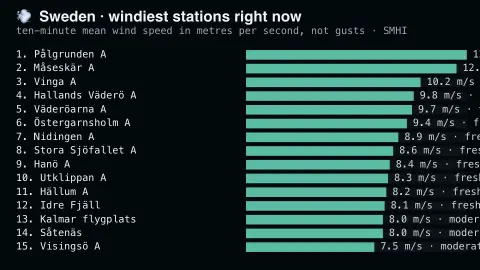
The Where The Wind Is screensaver ranks Sweden's weather stations by current wind speed in metres per second, with the corresponding Beaufort description beside each reading. It runs in the browser with nothing to install; press ESC to exit.
Live preview
Press ESC to leave fullscreen. Settings are saved in your browser only.
How the Where The Wind Is screensaver works
The saver reads SMHI, the Swedish meteorological and hydrological institute, key-free.
No account and no key: the request goes straight from your browser, or from this site's own refreshed copy of the feed where the source does not permit browser access.
Values are drawn on a canvas that resizes with the window, so it works on a laptop or a wall display.
If the source is unreachable the saver says so on screen rather than showing stale numbers as though they were current.
SMHI and the Swedish wind record
SMHI, the Swedish Meteorological and Hydrological Institute, is the national agency for weather and water. It runs an open data service for meteorological observations, licensed CC BY 4.0 and usable without registration or an API key, which exposes measurements by parameter, including wind speed and wind direction from its stations.
Wind is measured by an anemometer, and SMHI describes its wind speed series, in metres per second, as a 10-minute mean value rather than the peak puff. Gusts are a different quantity from the mean, so a station can read a modest average while short bursts are much stronger, which matters for shipping, construction and storm damage.
Station values reflect the exact site, so a sheltered inland station and an exposed coastal one will read very differently under the same weather. Not every station measures every parameter, and SMHI distinguishes stations it monitors and quality checks from additional stations whose values are not quality checked. The numbers are observations, not forecasts, and they say nothing about what the wind will do in the next hour.
A worked example
Fifteen stations ranked windiest first, each with its speed and the Beaufort term — light breeze, fresh breeze, near gale. These are ten-minute mean speeds, not gusts, which matters: a station reading 12 m/s as a mean is a genuinely windy day, and its gusts will be considerably higher.
Settings & tips
- Accent and Background recolour the display without changing the data.
- Add it to a Multi-view grid to watch it alongside other live savers.
- Press ESC at any time to leave fullscreen.
Frequently asked questions
- Why means rather than gusts?
- Because means are what the standard observation reports and what wind power output follows. Gusts are peaks lasting seconds; the mean is what actually determines how much a turbine generates.
- What is the Beaufort scale?
- A descriptive scale from calm to hurricane, defined by observable effects rather than instruments — the wording predates anemometers. It survives because it translates a number into something a person can picture.
- Is this real data?
- Yes. It comes from SMHI, the Swedish meteorological and hydrological institute, key-free. Nothing is invented or simulated, and if the source cannot be reached the saver reports that instead of drawing something plausible.
- Does it cost anything or need an account?
- No. Every screensaver here is free, runs in the browser and needs no sign-up. This one uses a public API that requires no key.
- Why do coastal stations usually show higher wind speeds?
- Open water and low terrain offer little friction to the air, so wind is generally stronger and steadier there than over forest or town, which slow and disturb it.
- Is the wind speed a gust or an average?
- SMHI describes its wind speed observations as a 10-minute mean value. A gust is a short burst and is a separate quantity, so it can be well above the average.
- Does SMHI correct or revise this data?
- Recent observations sit in a period that is still under quality control, while older data is in a quality-controlled archive. Some stations are not quality checked at all, so a value can differ from what was later archived.