Britain's Demand Curve Screensaver
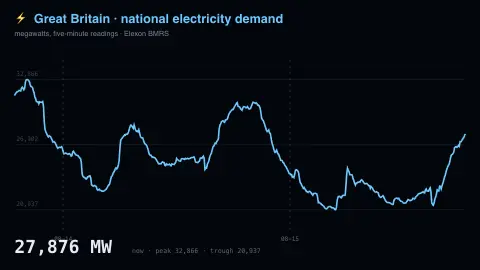
The Britain's Demand Curve screensaver plots national electricity demand in megawatts at five-minute resolution across two days, so the previous day's shape sits behind today's. It runs in the browser with nothing to install; press ESC to exit.
Live preview
Press ESC to leave fullscreen. Settings are saved in your browser only.
How the Britain's Demand Curve screensaver works
The saver reads Elexon's BMRS demand outturn feed, key-free.
No account and no key: the request goes straight from your browser, or from this site's own refreshed copy of the feed where the source does not permit browser access.
Values are drawn on a canvas that resizes with the window, so it works on a laptop or a wall display.
If the source is unreachable the saver says so on screen rather than showing stale numbers as though they were current.
Reading Britain's electricity load
Elexon administers the Balancing and Settlement Code, the rulebook for balancing and settling electricity in Great Britain. The Balancing Mechanism Reporting Service (BMRS) is the main source of operational data for these arrangements, and its open data includes outturn demand datasets such as the Initial National Demand Outturn (INDO) and the Initial Transmission System Demand Outturn (ITSDO). Both are measured in megawatts as an average over a settlement period.
Electricity is traded and settled in half-hour settlement periods, which follow local time and start at midnight. A normal day has 48 of them, and the days when the clocks change have 46 or 50. The usual daily pattern is a morning rise, an evening peak and an overnight trough, with the exact shape changing by season and day of the week.
These are transmission-system figures, not a count of everything consumed. Published demand figures exclude embedded generation, mainly wind and solar connected to local networks without real-time metering, so they can sit well below total generation when renewable output is high. That makes the curve a picture of load on the national system rather than a complete tally of national electricity use.
A worked example
A single line across two days with dashed rules at midnight. The shape is the most predictable thing in the energy system and still worth watching: a trough around four in the morning, a climb through breakfast, a working-day plateau and the evening peak as a country comes home and starts cooking. Current demand, the peak and the trough are named beneath.
Settings & tips
- Accent and Background recolour the display without changing the data.
- Add it to a Multi-view grid to watch it alongside other live savers.
- Press ESC at any time to leave fullscreen.
Frequently asked questions
- Why does demand peak in the evening?
- Because domestic activity concentrates there. Cooking, lighting, heating and entertainment all rise as people get home, and they do it at roughly the same time, so millions of small decisions add into one national spike.
- Is this all the electricity Britain uses?
- It is transmission-level demand, which excludes generation embedded in the distribution network — most notably rooftop solar. On a sunny afternoon real consumption is higher than this line shows, because some of it never touches the transmission grid.
- Is this real data?
- Yes. It comes from Elexon's BMRS demand outturn feed, key-free. Nothing is invented or simulated, and if the source cannot be reached the saver reports that instead of drawing something plausible.
- Does it cost anything or need an account?
- No. Every screensaver here is free, runs in the browser and needs no sign-up. This one uses a public API that requires no key.
- What is a settlement period?
- It is the half-hour block in which electricity is traded and settled in Great Britain. A normal day has 48, a clocks-forward day 46 and a clocks-back day 50.
- Does the demand figure include rooftop solar?
- Not directly. Published demand figures exclude embedded generation such as small solar and wind connected to local networks, so that output reduces what the national system has to supply.
- Is Northern Ireland included?
- No. BMRS is part of the Great Britain balancing and settlement arrangements run by Elexon. Northern Ireland is part of the all-island Single Electricity Market with the Republic of Ireland.