Keeping The Lights On Screensaver
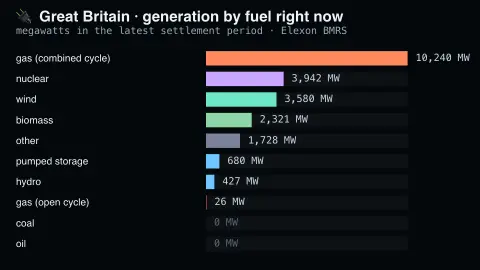
The Keeping The Lights On screensaver shows how much electricity each fuel type is generating in Great Britain right now — gas, nuclear, wind, biomass, hydro and coal — in megawatts for the latest settlement period. It runs in the browser with nothing to install; press ESC to exit.
Live preview
Press ESC to leave fullscreen. Settings are saved in your browser only.
How the Keeping The Lights On screensaver works
The saver reads Elexon's BMRS, the GB electricity market settlement service, key-free.
No account and no key: the request goes straight from your browser, or from this site's own refreshed copy of the feed where the source does not permit browser access.
Values are drawn on a canvas that resizes with the window, so it works on a laptop or a wall display.
If the source is unreachable the saver says so on screen rather than showing stale numbers as though they were current.
Elexon, settlement periods and Britain's generation mix
Elexon administers the Balancing and Settlement Code for Great Britain’s electricity market. Its job includes imbalance settlement, which compares what each party contracted to deliver or use with what was metered, and works out the resulting charges. The Balancing Mechanism Reporting Service, or BMRS, publishes market data, now through Elexon’s Insights Solution, and that includes generation outturn by fuel type.
Electricity is traded and settled in half-hour blocks called settlement periods. Period 1 starts at midnight local time, an ordinary day has 48 periods, and the days the clocks change have 46 or 50. A figure in megawatts is an average power over its interval. Fuel categories include gas, nuclear, wind, biomass, hydro and coal, among others, and a catch-all category covers generation whose fuel type is not recorded.
These figures come from metered generation, so small plant on local distribution networks, rooftop solar above all, is not fully captured and the display understates solar in particular. Other sources estimate embedded wind and solar separately. Output swings with weather and demand, which is why the mix can change a lot from one period to the next.
A worked example
Each fuel gets a coloured bar scaled to its output. Gas and wind usually lead, nuclear runs flat because it always does, and coal is a flat zero — which is the most remarkable number on the board, given that Britain ran on coal for two centuries. Interconnector rows are excluded here because imports are not domestic generation; they have their own screensaver.
Settings & tips
- Accent and Background recolour the display without changing the data.
- Add it to a Multi-view grid to watch it alongside other live savers.
- Press ESC at any time to leave fullscreen.
Frequently asked questions
- What is a settlement period?
- A half hour. The GB electricity market settles in 48 periods a day, and every volume and price is reported against one, which is why the feed arrives in half-hourly chunks.
- Why is coal usually zero?
- Because Britain closed its last coal-fired power station in 2024. The category remains in the feed, and seeing it sit at zero period after period is a more vivid record of that than any headline.
- Is this real data?
- Yes. It comes from Elexon's BMRS, the GB electricity market settlement service, key-free. Nothing is invented or simulated, and if the source cannot be reached the saver reports that instead of drawing something plausible.
- Does it cost anything or need an account?
- No. Every screensaver here is free, runs in the browser and needs no sign-up. This one uses a public API that requires no key.
- Why is solar so small in this data?
- The fuel-type figures are based on metered generation, and much solar sits on local distribution networks, so only part of the real total shows up here.
- How many settlement periods are in a day?
- Forty-eight on an ordinary day, each half an hour long. Days when the clocks go forward have 46, and days when they go back have 50.