Two Centuries Of Spots Screensaver
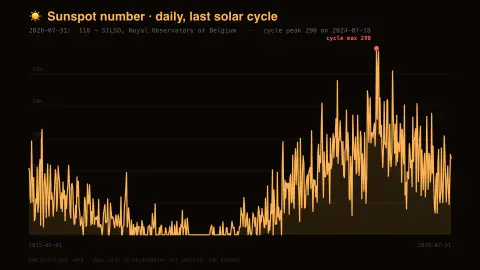
The Two Centuries Of Spots screensaver shows sILSO's daily total sunspot number, gathered key-less by the pipeline. It's free, runs in your browser, and ESC exits.
Live preview
Press ESC to leave fullscreen. Settings are saved in your browser only.
How the Two Centuries Of Spots screensaver works
The saver reads the source described above and draws it on a canvas — no account, no tracking.
SILSO's daily total sunspot number, gathered key-less by the pipeline. The record runs back to 1818; this shows about one solar cycle. Days nobody observed are dropped rather than drawn as zero, which would invent a lull that never happened.
It refreshes on a schedule, so what you see stays current.
Colours and any options can be changed in settings; nothing is stored beyond your own browser.
Counting spots since Wolf
Sunspots are dark patches on the Sun's surface. SILSO, the Sunspot Index and Long-term Solar Observations, is the World Data Center for producing, preserving and disseminating the international sunspot number, and sits within the Royal Observatory of Belgium's SIDC. Its daily total sunspot number runs from 1 January 1818, monthly means from 1749, and yearly means from 1700.
The index descends from the Wolf number, formulated as R = k(10g + s), where s is the number of individual spots, g the number of groups and k an observatory factor. The idea of compiling counts from several observers goes back to Rudolf Wolf in Zurich in 1848. A revised international series was released on 1 July 2015; it raised values by a factor of 1.6 and dropped an earlier 0.6 scaling applied after 1893, so current values follow the revised scale.
Heinrich Schwabe found the roughly eleven-year cycle in 1843, and Solar Cycle 25 began in December 2019 with a minimum smoothed sunspot number of 1.8. Days with no valid observation are left out rather than plotted as zero, so a gap does not masquerade as a quiet Sun.
A worked example
SILSO's daily total sunspot number, gathered key-less by the pipeline. The record runs back to 1818; this shows about one solar cycle. Days nobody observed are dropped rather than drawn as zero, which would invent a lull that never happened.
Settings & tips
- Accent and Background recolour the display.
- Every value on screen comes from the live source — nothing is simulated.
- Press ESC to leave fullscreen.
Frequently asked questions
- Is this real data?
- Yes — it comes from the source named on this page and is refreshed on a schedule.
- Is a key needed?
- No. This source is fully key-less.
- Is it free?
- Yes, and it runs entirely in your browser.
- What do the g and s in the Wolf formula mean?
- The Wolf number is R = k(10g + s). Here g is the number of sunspot groups, s the number of individual spots and k an observatory factor, so each group counts for ten.
- Why do older published values look lower?
- A revised international series released on 1 July 2015 raised values by a factor of 1.6 and dropped the 0.6 scaling applied after 1893, so figures from before the revision are on a different scale.