Space Weather Screensaver
The Space Weather screensaver shows NOAA's live aurora-oval forecast glowing over a world map, alongside the planetary Kp-index and geomagnetic storm level on a colour-coded gauge. The data is from NOAA's Space Weather Prediction Center — no key needed. It's free, runs in your browser, and ESC exits.
Live preview
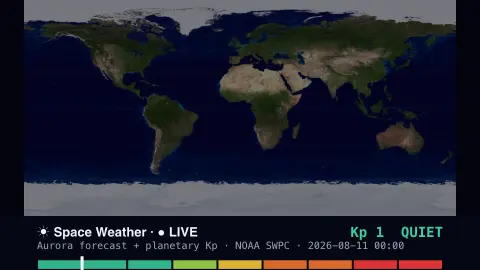
Press ESC to leave fullscreen. Settings are saved in your browser only.
How the Space Weather screensaver works
The saver pulls two live products from NOAA's Space Weather Prediction Center: the OVATION aurora model — a global grid of aurora probabilities — and the planetary Kp-index, the standard 0-to-9 measure of geomagnetic activity.
The aurora grid has tens of thousands of points, so the saver paints them once to an offscreen image: each becomes a small green (or, where intensity is high, violet) glow, additively blended so the bright auroral ovals form around both poles.
That glow is drawn over a dimmed world map and gently pulsed, so the ovals shimmer the way the real ones do.
Underneath, the latest Kp-index is plotted on a colour gauge from green (quiet) to red (severe storm), with the matching storm scale (G1–G5) labelled. Higher Kp means the aurora pushes further from the poles toward populated latitudes.
NOAA's aurora forecast and the Kp scale
The aurora oval shown here comes from NOAA’s Space Weather Prediction Center. Its OVATION model (Oval Variation, Assessment, Tracking, Intensity, and Online Nowcasting) was developed at Johns Hopkins APL. It estimates electron and proton precipitation, which correlates strongly with the aurora, and turns that into a viewing probability. Its main inputs are solar wind speed and the interplanetary magnetic field measured at the L1 point, about 1.6 million km upstream of Earth. The result is a map of where the glow is statistically likely, not a camera image of the sky.
The Kp-index summarises geomagnetic disturbance. The K-index measures the largest fluctuation in the horizontal component of Earth’s magnetic field over three hours, and the planetary Kp averages the standardised values from 13 observatories at geomagnetic latitudes between 44 and 60 degrees. It is an integer from 0 to 9, and Julius Bartels introduced the K-index in 1938. NOAA maps Kp 5 to the G1 storm level, 6 to G2, 7 to G3, 8 (and 9-) to G4 and 9 to G5.
The forecast lead time is short, about 30 to 90 minutes: the time the solar wind takes to travel from L1 to Earth. Visibility depends on much more than the model, since local darkness, cloud cover, moonlight and light pollution decide whether anyone on the ground can actually see anything.
A worked example
On a quiet day the gauge sits around Kp 2 · QUIET, with thin green ovals hugging the Arctic and Antarctic. During a geomagnetic storm it climbs — Kp 7 · G3 STORM — and the ovals swell and brighten, pushing south toward Canada, Scotland and Scandinavia, exactly when aurora chasers head out. The readout updates every few minutes.
Settings & tips
- The aurora glow and Kp gauge refresh automatically every few minutes — no settings needed to keep it current.
- Higher Kp (yellow to red on the gauge) means a stronger storm and aurora visible at lower latitudes.
- It needs an internet connection for the live NOAA data; offline it shows a short notice.
Frequently asked questions
- Is the aurora forecast real?
- Yes. It's NOAA's live OVATION aurora model plus the real planetary Kp-index, both from the Space Weather Prediction Center, refreshed every few minutes.
- What is the Kp-index?
- It's a 0-to-9 scale of global geomagnetic activity. Below 5 is quiet; 5 and above are geomagnetic storms, graded G1 to G5, when auroras grow and spread toward the equator.
- Where will the aurora be visible?
- The glowing ovals show where aurora is likely overhead. The higher the Kp, the further from the poles they reach — sometimes into the northern US, UK or central Europe.
- Does it need internet?
- Yes, it reads live NOAA feeds. Offline it shows a short notice instead of the map.
- Is the space weather screensaver free?
- Yes, free and browser-based with no key or download. Run it fullscreen and press ESC to exit.
- Why is the glow brightest in a ring around the poles?
- Charged particles are guided by Earth’s magnetic field toward rings centred on the magnetic poles, so the aurora concentrates in ovals rather than over the geographic poles.
- Does a high Kp always mean a visible aurora?
- No. Kp measures magnetic disturbance, not sky conditions, so cloud, daylight or a bright moon can hide a strong display.
- How is this different from a solar flare alert?
- Flares are sudden bursts on the Sun, while geomagnetic storms arise when plasma or fast solar wind reaches Earth, often a day or more later. They are related but forecast separately.