ISS Tracker Screensaver
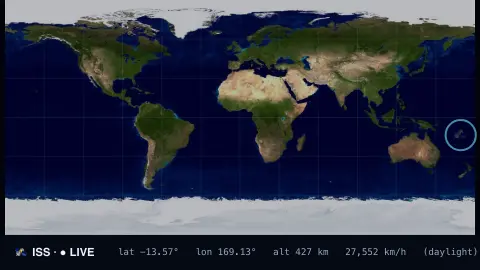
The ISS Tracker screensaver shows the International Space Station's live position over a world map, trailing its ground track and reporting its altitude and speed in real time. The data comes from the open wheretheiss.at API — no key needed. It's free, runs in your browser, and ESC exits.
Live preview
Press ESC to leave fullscreen. Settings are saved in your browser only.
How the ISS Tracker screensaver works
Every few seconds the saver asks the open wheretheiss.at API where the ISS is right now. The reply is a simple set of numbers: latitude, longitude, altitude (around 420 km) and ground speed (about 27,600 km/h).
That latitude and longitude is projected onto an equirectangular world map, so the station's marker sits directly over the point on Earth it's currently passing.
Each reported position is added to a ground track — the fading line trailing the marker — so you see the orbit's familiar sine-wave path sweep across the map, broken cleanly where it wraps the date line.
A panel reads out the live latitude, longitude, altitude and speed. The station completes an orbit roughly every 90 minutes, so over time the track marches steadily eastward.
Why the station traces a wavy line
The International Space Station is operated by five space agencies, NASA, Roscosmos, ESA, JAXA and the Canadian Space Agency, and it has been continuously occupied since November 2000. It orbits at roughly 400 kilometres, with a perigee around 413 km and an apogee around 422 km, at about 27,600 km/h. It falls around the planet rather than into it, taking about 93 minutes per orbit, or roughly 16 orbits a day.
Its orbit is inclined 51.6 degrees to the equator, so its ground track covers all latitudes between 51.6 degrees north and south and never reaches the poles. The track looks like a wave on a flat map because the orbit is a circle tilted against the equator, projected onto a rectangle. Each pass is shifted westward because the Earth turns beneath the orbit during the roughly 93 minutes of a circuit, about 23 degrees of longitude.
Altitude is not fixed. Thin atmosphere at that height drags the station down by about 2 km a month, so it needs periodic reboosts. You can spot it from the ground as a bright, steadily moving point after dusk or before dawn, when you are in darkness but the station is still sunlit. The positions on the map are only as precise as the feed behind them, good for orientation, not navigation.
A worked example
At a typical moment the readout might show lat 14.9° lon 47.7° alt 418 km 27,588 km/h — the ISS over the Arabian Sea on the climbing part of its orbit. Watch for a minute and the marker visibly moves; leave it running and the trailing track draws the full looping orbit. The visibility note shows whether the station is in daylight or Earth's shadow.
Settings & tips
- Refresh sets how often the live position is fetched — every few seconds keeps the marker moving smoothly.
- Track color recolours the orbit trail and the marker's halo.
- It needs an internet connection for the live position; offline it shows a short notice.
Frequently asked questions
- Is the ISS position real and live?
- Yes. It's fetched every few seconds from the open wheretheiss.at API, so the marker shows where the International Space Station actually is right now.
- How fast and high is the ISS?
- It orbits about 420 km up at roughly 27,600 km/h, circling the Earth about once every 90 minutes. The live figures are shown in the panel.
- What is the trailing line?
- That's the ground track — the path on Earth directly beneath the station. Its sine-wave shape comes from the orbit's tilt relative to the equator.
- Does it need an internet connection?
- Yes, it reads a live API. Opened from a local file with no connection, it shows a short notice instead of the map.
- Is the ISS tracker screensaver free?
- Yes, free and browser-based with no key or download. Run it fullscreen and press ESC to exit.
- Why does the ISS not fly over the poles?
- Its orbit is inclined about 51.6 degrees to the equator, so its ground track only reaches latitudes up to that angle, north and south.
- How can I see the ISS from the ground?
- Look for a bright, non-blinking light crossing the sky shortly after sunset or before sunrise, when the sky is dark where you are but the station is still lit by the Sun. Satellite-tracking sites publish pass times for your location.
- Does the ISS change its orbit?
- Yes. Atmospheric drag slowly lowers it, so it is boosted back up from time to time, and its height varies slightly over time.