Steam Top Games Screensaver
The Steam Top Games screensaver ranks the most-played games on Steam by real concurrent player count, drawn key-less from Valve's own public Steam API by a background pipeline (Steam's API doesn't allow direct browser access). It's free, runs in your browser, and ESC exits.
Live preview
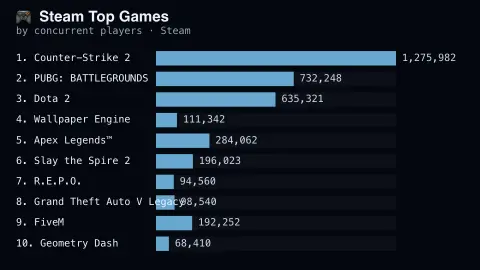
Press ESC to leave fullscreen. Settings are saved in your browser only.
How the Steam Top Games screensaver works
A background pipeline fetches Steam's real current most-played games list directly from Valve's public API, with no key required.
Each game ranks by real concurrent player count at the time of the last refresh.
The board eases smoothly as rankings shift on refresh.
Readings refresh on the pipeline's schedule, not live tick by tick.
Concurrent players on Steam, explained
Steam is Valve's digital storefront and game library for personal computers, and its Most Played chart ranks games by current players, shown beside a figure labelled peak today. Current players is a count of users with the game running at the moment the data was gathered, as opposed to people who bought it or who have played it at some point in the past.
Concurrent counts favour games that people leave running or play in long sessions, especially multiplayer titles with large communities. A game with huge sales but a single-player story that players finish in a weekend may rarely stay in the top ranks. Free-to-play games can also do well in such a chart, since they have no purchase barrier.
The chart covers Steam alone, so it leaves out games played on consoles, on phones or through rival launchers and stores. Updates, sales and free weekends can send a title up the list, and the list is a snapshot taken when the data was gathered, so it can look different an hour later. A rank here shows how active a game's community is on that platform, and is not a verdict on quality.
A worked example
You'll typically see a handful of massive live-service games trading the top spots — a real snapshot of what millions of people are playing on Steam, refreshed by the pipeline.
Settings & tips
- Accent recolours the bars.
- Run
automation/run.py steamtopon your pipeline machine to refresh the data. - Concurrent players reflects Steam only, not console or other PC platforms.
Frequently asked questions
- Why does it need a pipeline?
- Steam's public API doesn't allow direct browser requests (no CORS), so a small background script fetches it and saves a snapshot the saver loads — no key needed, just a server-side fetch.
- Is this all PC gaming?
- No — it reflects Steam's own real concurrent player counts, not other platforms or storefronts.
- How current is it?
- As current as the pipeline's last refresh — Steam itself publishes the counts continuously.
- Is it free?
- Yes — free, no download, in your browser.
- What is the difference between current and peak players?
- Current is the count at a particular moment, while peak is the highest value reached over a stretch such as the day so far. The peak is always at least as large as the current figure.
- Do players on other platforms count?
- Only Steam users are included, so a game that is widely played on consoles or other launchers may look smaller than it really is.
- Why does the ranking change during the day?
- The chart is a snapshot of who is playing at the time the data was gathered, so changing player counts, updates and sales can all reorder it between refreshes.