Spain, Published Screensaver
The Spain, Published screensaver streams datasets from Spain's national open data portal, which federates the central state with the autonomous communities. It runs in the browser with nothing to install; press ESC to exit.
Live preview
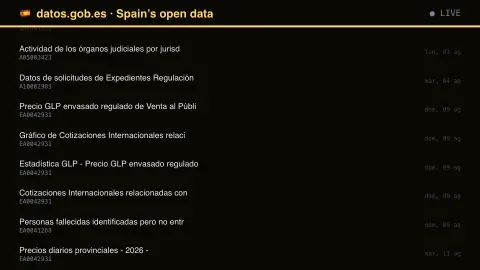
Press ESC to leave fullscreen. Settings are saved in your browser only.
How the Spain, Published screensaver works
The saver reads datos.gob.es, Spain's national open data catalogue.
No account and no key: the request goes straight from your browser, or from this site's own refreshed copy of the feed where the source does not permit browser access.
Values are drawn on a canvas that resizes with the window, so it works on a laptop or a wall display.
If the source is unreachable the saver says so on screen rather than showing stale numbers as though they were current.
How Spain federates its open data
datos.gob.es is Spain's national open data portal; its pages carry the branding of the Ministry for Digital Transformation and Public Service, and Red.es is named as data controller. Its distinctive feature is federation: public bodies publish their dataset metadata in a preset structured format, and the portal loads it so that users get a single access point regardless of which administration published the data.
The federated catalogue gathers data from more than 75 entities at all administrative levels. Examples named by the portal include the National Statistics Institute (INE), the Xunta de Galicia, Zaragoza City Council, the National Geographic Information Centre (CNIG) and the Centre for Sociological Research (CIS). The portal also offers an API and a SPARQL endpoint for querying catalogue metadata.
Spain describes datasets with the NTI-RISP technical interoperability standard, which is based on the DCAT vocabulary. Because the portal aggregates, the same underlying information may appear in several places, and a count of entries by publisher mostly reflects publishing practice, not how much public information each administration holds.
A worked example
Each row gives a dataset title and its publisher. Because the portal federates the regions, the feed mixes national ministries with Catalan, Basque and Galician regional governments, and the titles arrive in those languages accordingly. The API is not CKAN but a bespoke RDF-backed service whose titles come back either as a plain string or as an array of language-tagged objects, so both shapes are handled.
Settings & tips
- Accent and Background recolour the display without changing the data.
- Add it to a Multi-view grid to watch it alongside other live savers.
- Press ESC at any time to leave fullscreen.
Frequently asked questions
- Why do titles appear in several languages?
- Because Spain has several official languages and regional governments publish in theirs. The saver prefers Castilian where a record offers it and falls back to whatever the record has rather than showing a blank row.
- What are the autonomous communities?
- Spain's seventeen regional governments, which hold substantial devolved powers and publish their own data. The national portal indexes them alongside central government.
- Is this real data?
- Yes. It comes from datos.gob.es, Spain's national open data catalogue. Nothing is invented or simulated, and if the source cannot be reached the saver reports that instead of drawing something plausible.
- Does it cost anything or need an account?
- No. Every screensaver here is free, runs in the browser and needs no sign-up. This one uses a public API that requires no key.
- Who publishes the data on the portal?
- Many public bodies at all administrative levels. Each publishes its own metadata, and the portal federates those catalogues into a single access point.
- How is the metadata described?
- Datasets are described according to Spain's NTI-RISP standard, which is based on the DCAT vocabulary.