Spain's Balance Screensaver
The Spain's Balance screensaver shows where Spain's electricity came from over the last full day, source by source, in megawatt-hours from the national grid operator. It runs in the browser with nothing to install; press ESC to exit.
Live preview
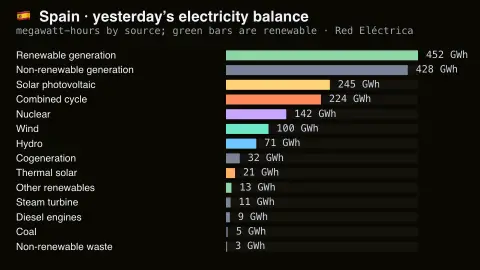
Press ESC to leave fullscreen. Settings are saved in your browser only.
How the Spain's Balance screensaver works
The saver reads Red Eléctrica's public API, key-free.
No account and no key: the request goes straight from your browser, or from this site's own refreshed copy of the feed where the source does not permit browser access.
Values are drawn on a canvas that resizes with the window, so it works on a laptop or a wall display.
If the source is unreachable the saver says so on screen rather than showing stale numbers as though they were current.
Spain's electricity system and its grid operator
Red Eléctrica de España operates Spain's high-voltage transmission grid and is responsible for keeping generation matched to demand. It publishes generation data through REData, a service with a REST API that returns JSON. Spain connects to Portugal, France and Morocco, but low interconnection capacity with the rest of Europe leaves the Iberian Peninsula electrically semi-isolated, so the domestic balance of supply and demand matters more than in a well-connected country.
The mix on screen is split by technology. Wind and solar photovoltaic are the weather-dependent sources, while nuclear, hydro, combined-cycle gas and cogeneration are among the others. Spain has a strong solar resource and has added a great deal of solar capacity, so the daytime balance can look very different from the evening, when the sun has gone and gas and hydro are called on to fill the gap.
Energy figures come as a total over a period, not an instantaneous reading, and the daily total reflects both the weather and demand patterns, which vary between weekdays, holidays and seasons. Red Eléctrica notes that its generation sections do not include estimated output from self-consumption installations such as rooftop solar, and published figures can be revised afterwards. The display is a view of one day's generation, not a long-term trend.
A worked example
Each source gets a bar, renewables in green tones and the rest in grey and orange. Solar photovoltaic is usually the largest single renewable line by a distance — Spain gets more sun than anywhere else in Europe and has built accordingly. Figures are energy over the day rather than instantaneous power, so this is a balance sheet rather than a snapshot.
Settings & tips
- Accent and Background recolour the display without changing the data.
- Add it to a Multi-view grid to watch it alongside other live savers.
- Press ESC at any time to leave fullscreen.
Frequently asked questions
- Why megawatt-hours rather than megawatts?
- Because this is a daily balance. Megawatts measure power at an instant; megawatt-hours measure the energy delivered over a period, which is the right unit for asking what the country actually ran on yesterday.
- What is thermal solar?
- Concentrated solar power: mirrors focus sunlight to heat a fluid and drive a turbine. Spain built a great deal of it and it behaves differently from photovoltaic panels, because the stored heat lets it keep generating after sunset.
- Is this real data?
- Yes. It comes from Red Eléctrica's public API, key-free. Nothing is invented or simulated, and if the source cannot be reached the saver reports that instead of drawing something plausible.
- Does it cost anything or need an account?
- No. Every screensaver here is free, runs in the browser and needs no sign-up. This one uses a public API that requires no key.
- How does Spain's grid differ from others in Europe?
- Its interconnection with neighbouring countries is low relative to its size, which effectively isolates the Iberian Peninsula from the wider European grid.
- What is cogeneration?
- Combined heat and power: a plant that produces electricity and useful heat from the same fuel, commonly used in industrial sites.
- Why does the solar share change so much over a day?
- Photovoltaic output follows sunlight, so it rises through the morning, peaks around midday and falls to nothing at night, when other sources fill in.