Spacecraft Still Tracked Screensaver
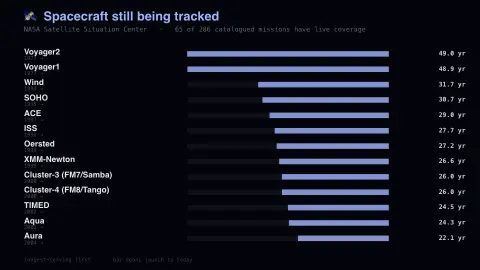
The Spacecraft Still Tracked screensaver shows the satellites NASA's Satellite Situation Center can currently compute a position for, key-less. It's free, runs in your browser, and ESC exits.
Live preview
Press ESC to leave fullscreen. Settings are saved in your browser only.
How the Spacecraft Still Tracked screensaver works
The saver reads the source described above and draws it on a canvas — no account, no tracking.
The satellites NASA's Satellite Situation Center can currently compute a position for, key-less. The catalogue reaches back to the 1960s and is mostly dead missions, so this keeps only the ones whose coverage runs past today and ranks them by how long they have been on station.
It refreshes on a schedule, so what you see stays current.
Colours and any options can be changed in settings; nothing is stored beyond your own browser.
What the Satellite Situation Center tracks
SSCWeb, the Satellite Situation Center web service, is operated by NASA’s Space Physics Data Facility (SPDF) at Goddard Space Flight Center, developed jointly with the National Space Science Data Center. It takes spacecraft locations and places them in geophysical regions, mapping positions along Earth’s magnetic field lines, to support mission planning and analysis of data from several missions at once.
The service offers locator tables, 2-D orbit plots, 4-D orbit animations and conjunction queries that report when spacecraft were in particular magnetospheric regions or shared a magnetic flux tube. Its documentation describes a database of ephemeris (orbit position) data for more than 150 satellites, each with a stated time range, a data resolution, and a flag saying whether the orbit is definitive (reconstructed) or predictive.
This is therefore a registry of positions that can be computed, not a live tracker of everything in orbit. A spacecraft appears because the service holds orbit data for a period, which is different from the spacecraft still being operational. Each mission’s listed time range tells you the period for which a position can be calculated.
A worked example
The satellites NASA's Satellite Situation Center can currently compute a position for, key-less. The catalogue reaches back to the 1960s and is mostly dead missions, so this keeps only the ones whose coverage runs past today and ranks them by how long they have been on station.
Settings & tips
- Accent and Background recolour the display.
- Every value on screen comes from the live source — nothing is simulated.
- Press ESC to leave fullscreen.
Frequently asked questions
- Is this real data?
- Yes — it comes from the source named on this page and is refreshed on a schedule.
- Is a key needed?
- No. This source is fully key-less.
- Is it free?
- Yes — free, no download, in your browser.
- Is every listed spacecraft still working?
- No. Listing only means the service holds orbit data for some period. Many missions have ended, and their positions are available from stored ephemeris data.
- What is the difference between definitive and predictive orbit data?
- SSCWeb’s documentation flags each ephemeris as either definitive or predictive. Predictive data is a forecast of where a spacecraft will be, while definitive data is the reconstructed actual orbit.
- Why would researchers need to know where a spacecraft was?
- To relate a measurement to its location, for example which magnetospheric region the spacecraft was in, or whether two spacecraft were on the same magnetic field line.