Planetary Ephemeris Screensaver
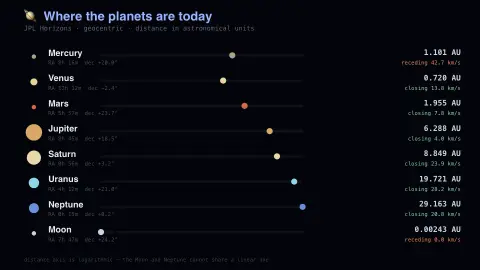
The Planetary Ephemeris screensaver shows each planet's real position and distance from Earth today, computed by JPL's Horizons service and gathered key-less by the pipeline. It's free, runs in your browser, and ESC exits.
Live preview
Press ESC to leave fullscreen. Settings are saved in your browser only.
How the Planetary Ephemeris screensaver works
The saver reads the source described above and draws it on a canvas — no account, no tracking.
Each planet's real position and distance from Earth today, computed by JPL's Horizons service and gathered key-less by the pipeline. Horizons is the same system mission planners use; distances are in astronomical units on a logarithmic scale.
It refreshes on a schedule, so what you see stays current.
Colours and any options can be changed in settings; nothing is stored beyond your own browser.
What JPL Horizons computes
Horizons is an online solar-system data and ephemeris service run by NASA JPL's Solar System Dynamics Group, where an ephemeris is a table of where bodies are at given times. It produces ephemerides for planets, moons, asteroids, comets, the Sun and selected spacecraft. Positions of major bodies are interpolated from precomputed planetary ephemerides such as DE441, while asteroids and comets are numerically integrated from stored orbital elements.
Observer tables can be topocentric or geocentric, and the saver's values are geocentric, meaning as seen from the centre of the Earth. Right ascension and declination are the sky's equivalent of longitude and latitude, and tell you where in the sky a planet sits. The distance is in astronomical units, one AU being roughly 150 million kilometres, the Earth-Sun distance scale, so light takes a bit over eight minutes to travel one. A rate shows how fast that distance is changing, with negative values meaning the planet is approaching.
Because the planets lie at very different distances, the saver plots distance on a logarithmic scale, which is why Mercury and Neptune fit on the same screen. Positions are for a single date, a computed prediction rather than an observation, and they do not tell you whether the planet is above your horizon.
A worked example
Each planet's real position and distance from Earth today, computed by JPL's Horizons service and gathered key-less by the pipeline. Horizons is the same system mission planners use; distances are in astronomical units on a logarithmic scale.
Settings & tips
- Accent and Background recolour the display.
- Every number on screen comes from the live source — nothing is simulated.
- Press ESC to leave fullscreen.
Frequently asked questions
- Is this real data?
- Yes — it comes from the source named on this page and is refreshed on a schedule.
- Is a key needed?
- No. This source is fully key-less.
- Is it free?
- Yes — free, no download, in your browser.
- What is an astronomical unit?
- A unit of distance based on the Earth-Sun distance, roughly 150 million kilometres. It is convenient for describing distances within the Solar System.
- Does this tell me where to look in the sky?
- Only roughly. Right ascension and declination give a direction relative to the stars, but whether the planet is visible depends on your location and time of night.
- Why is the distance on a log scale?
- The planets are spread over a vast range of distances, from a fraction of an AU to about thirty. A logarithmic scale lets near and distant planets share one readable display.