The Sun Sending Word Screensaver
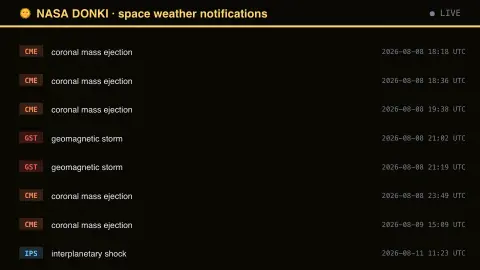
The The Sun Sending Word screensaver shows space weather notifications from NASA's DONKI, key-less. Every row is an alert issued to spacecraft operators and power grids — CME is a coronal mass ejection leaving the Sun, GST a geomagnetic storm arriving at Earth. The lag between a CME notice and the GST that follows is the two or three days the plasma takes to cross ninety-three million miles. It's free, runs in your browser, and ESC exits.
Live preview
Press ESC to leave fullscreen. Settings are saved in your browser only.
How the The Sun Sending Word screensaver works
The saver reads the source described above and draws it on a canvas — no account, no tracking.
Space weather notifications from NASA's DONKI, key-less. Every row is an alert issued to spacecraft operators and power grids — CME is a coronal mass ejection leaving the Sun, GST a geomagnetic storm arriving at Earth. The lag between a CME notice and the GST that follows is the two or three days the plasma takes to cross ninety-three million miles.
It refreshes on a schedule, so what you see stays current.
Colours can be changed in settings; nothing is stored beyond your own browser.
Space weather notices and their codes
DONKI stands for Database Of Notifications, Knowledge, Information. It is run by NASA's Community Coordinated Modeling Center and serves space weather forecasters, scientists and the wider community with near-real-time analyses of observations, model outputs and notifications, mostly produced by NASA's Moon-to-Mars Space Weather Analysis Office. It also offers a searchable knowledge base, links between related events and a web API. The feed this screensaver shows is the stream of notifications posted there.
Each event has a short type code. FLR is a solar flare, CME a coronal mass ejection, GST a geomagnetic storm, SEP a solar energetic particle event, IPS an interplanetary shock, MPC a magnetopause crossing, RBE a radiation belt enhancement and HSS a high speed stream. Together they trace a chain from eruption on the Sun to effects near Earth, though not every event in the chain is reported each time.
The language is technical because the audience is. A CME notice describes a forecast, not a certainty: whether the cloud reaches Earth, when, and how strongly are all estimates that can be revised as new observations arrive, and some events pass Earth by.
A worked example
Space weather notifications from NASA's DONKI, key-less. Every row is an alert issued to spacecraft operators and power grids — CME is a coronal mass ejection leaving the Sun, GST a geomagnetic storm arriving at Earth. The lag between a CME notice and the GST that follows is the two or three days the plasma takes to cross ninety-three million miles.
Settings & tips
- Accent and Background recolour the display.
- Every value on screen comes from the live source — nothing is simulated.
- Press ESC to leave fullscreen.
Frequently asked questions
- Is this real data?
- Yes — it comes from the source named on this page and is refreshed on a schedule.
- Is a key needed?
- No. This source is fully key-less.
- Is it free?
- Yes, and it runs entirely in your browser.
- Does a notification mean something is about to happen to Earth?
- Not necessarily. Some notices cover events that miss Earth, and forecasts of arrival time and strength carry real uncertainty.
- Who writes the messages?
- DONKI is run by NASA's Community Coordinated Modeling Center, and its analyses and notifications come mainly from the Moon-to-Mars Space Weather Analysis Office.
- What is the difference between a flare and a CME?
- A flare is a burst of light and radiation, which travels at the speed of light, while a CME is a cloud of plasma that takes much longer to arrive. They can happen together but are separate phenomena.