Space Weather Alerts Screensaver
The Space Weather Alerts screensaver shows the watches, warnings and alerts NOAA's Space Weather Prediction Center issues, key-less. These are the notices that go to power grid, aviation and satellite operators when the Sun acts up. It's free, runs in your browser, and ESC exits.
Live preview
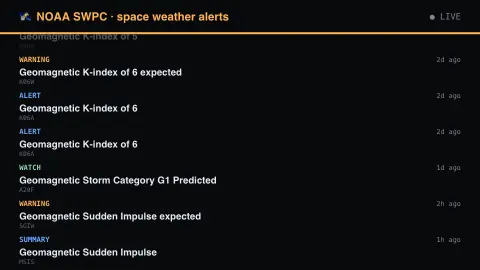
Press ESC to leave fullscreen. Settings are saved in your browser only.
How the Space Weather Alerts screensaver works
The saver reads NOAA's Space Weather Prediction Center directly in your browser — no key and no account.
The watches, warnings and alerts NOAA's Space Weather Prediction Center issues, key-less.
It refreshes on a schedule, so what you see stays current.
Colours can be changed in settings; nothing is stored beyond your own browser.
How NOAA classifies space weather
The Space Weather Prediction Center is part of NOAA's National Weather Service and provides alerts, watches and warnings to the public about what to expect from space weather, much as local forecast offices issue bulletins for terrestrial weather. Its bulletins convey levels of severity of solar activity that can be expected to affect Earth's environment.
Many are expressed on the NOAA Space Weather Scales, which have numbered levels like hurricane and tornado scales, from 1 (minor) to 5 (extreme). The G scale covers geomagnetic storms, with G1 corresponding to a Kp of 5 and G5 to a Kp of 9. The S scale covers solar radiation storms, rated by the flux of particles of at least 10 MeV. The R scale covers radio blackouts, tied to the peak X-ray flux of solar flares: flare classes run A, B, C, M and X, and R5 corresponds to X20.
A rating describes a physical disturbance, not what you will see. The scales list possible effects on power systems, spacecraft, radio and navigation, and for geomagnetic storms they note how far from the poles aurora has been seen, from northern Michigan and Maine at G1 to as low as Florida and southern Texas at G5. Solar wind monitors about 1.5 million km upstream of Earth give only a 20 to 60 minute warning of disturbances.
A worked example
The watches, warnings and alerts NOAA's Space Weather Prediction Center issues, key-less. These are the notices that go to power grid, aviation and satellite operators when the Sun acts up.
Settings & tips
- Accent and Background recolour the display.
- Data comes straight from NOAA's Space Weather Prediction Center in your browser.
- Press ESC to leave fullscreen.
Frequently asked questions
- Is this real data?
- Yes — it comes from NOAA's Space Weather Prediction Center and is refreshed on a schedule.
- Is a key needed?
- No. This source is fully key-less.
- Is it free?
- Yes — free, no download, in your browser.
- What do the G, S and R scales stand for?
- G is geomagnetic storms, S is solar radiation storms and R is radio blackouts, each rated from 1 (minor) to 5 (extreme).
- How does the G scale relate to the Kp index?
- The geomagnetic storm scale is defined by Kp: G1 corresponds to Kp 5, G2 to Kp 6, G3 to Kp 7, G4 to Kp 8 (including a 9-minus) and G5 to Kp 9.
- Does a strong alert mean I will see aurora?
- Not automatically. NOAA lists the latitudes where aurora has been seen at each storm level, and visibility also depends on local darkness and cloud cover.