The Internet, Written Down Screensaver
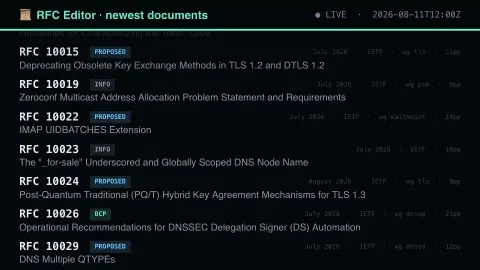
The The Internet, Written Down screensaver shows the newest RFCs with their current status, gathered key-less by the pipeline from a 13 MB index. It's free, runs in your browser, and ESC exits.
Live preview
Press ESC to leave fullscreen. Settings are saved in your browser only.
How the The Internet, Written Down screensaver works
The saver reads the source described above and draws it on a canvas — no account, no tracking.
The newest RFCs with their current status, gathered key-less by the pipeline from a 13 MB index. An RFC keeps its number forever and is never revised; the series changes its mind by publishing a new one, so a document's status is what it is now.
It refreshes on a schedule, so what you see stays current.
Colours and any options can be changed in settings; nothing is stored beyond your own browser.
The RFC series, in brief
RFC stands for Request for Comments. The series began with RFC 1, Host Software, written by Steve Crocker of UCLA and dated 7 April 1969, and the name stuck even though RFCs are now finished documents rather than informal notes. Today they are edited and published by the RFC Editor, and they come through several streams: the IETF, the IAB, the IRTF and independent submissions. Only documents in the IETF stream are reviewed by the IETF bodies, which is one reason an RFC is not automatically an engineering consensus.
The text of an RFC does not change once published. When something moves on, a newer RFC updates or obsoletes the old one, and that relationship is recorded in the document headers and the index. Each RFC also carries a category: Standards Track, Best Current Practice, Experimental, Informational or Historic. A status that changes later, such as moving to Historic, is tracked on a separate information page rather than by editing the text.
Standards Track documents are the ones that can become Proposed Standards and then Internet Standards, so many RFCs are not standards at all. The list on screen shows the newest numbers from the RFC Editor's index with their title and current status. Titles can be dense, because most RFCs are written for engineers who implement protocols.
A worked example
The newest RFCs with their current status, gathered key-less by the pipeline from a 13 MB index. An RFC keeps its number forever and is never revised; the series changes its mind by publishing a new one, so a document's status is what it is now.
Settings & tips
- Accent and Background recolour the display.
- Every value on screen comes from the live source — nothing is simulated.
- Press ESC to leave fullscreen.
Frequently asked questions
- Is this real data?
- Yes — it comes from the source named on this page and is refreshed on a schedule.
- Is a key needed?
- No. This source is fully key-less.
- Is it free?
- Yes, and it runs entirely in your browser.
- Does every RFC define an internet standard?
- No. RFCs are categorised as Standards Track, Best Current Practice, Experimental, Informational or Historic, and only Standards Track documents are on the path to becoming standards.
- Why do RFC numbers never change?
- A number identifies one fixed text. If something needs correcting or replacing, a new RFC is published that updates or obsoletes the earlier one.
- What does obsoleted mean?
- The newer RFC replaces the older one, and the header of each points to the other. The old document stays in the archive, but implementers should follow the newer text.