The Internet, Still Argued About Screensaver
The The Internet, Still Argued About screensaver shows internet-Drafts as they are filed with the IETF Datatracker, key-less. Anyone can file one and most quietly lapse after six months, which makes this a far better picture of current concerns than the list of things that were agreed. It's free, runs in your browser, and ESC exits.
Live preview
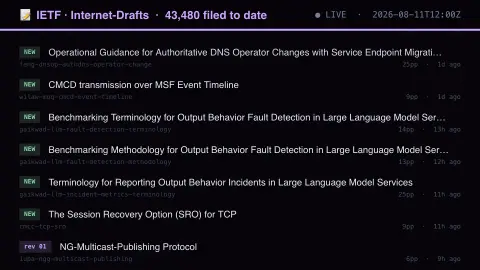
Press ESC to leave fullscreen. Settings are saved in your browser only.
How the The Internet, Still Argued About screensaver works
The saver reads the source described above and draws it on a canvas — no account, no tracking.
Internet-Drafts as they are filed with the IETF Datatracker, key-less. Anyone can file one and most quietly lapse after six months, which makes this a far better picture of current concerns than the list of things that were agreed.
It refreshes on a schedule, so what you see stays current.
Colours and any options can be changed in settings; nothing is stored beyond your own browser.
How an Internet-Draft becomes anything
The Internet Engineering Task Force develops technical standards for the internet, working through open mailing lists and meetings. The working documents are Internet-Drafts, which anyone can author and submit through the IETF Datatracker. A draft has no formal status and should not be cited as a standard: it is only valid for six months unless it is revised, and it gains standing only if a working group adopts it or it is approved as an RFC.
The file name carries information. A draft with draft-ietf- at the front has been adopted by an IETF working group, while a name beginning with an author’s surname is an individual submission that no group has formally taken up. The revision suffix such as -00 marks a first version, and each update increments it. The name also usually includes a working-group label and a topic.
A new draft means someone proposed something, not that it has support or will be adopted. The list is good evidence of what engineers are exploring, from routing to transport, security and emerging protocols, but it is not a record of decisions.
A worked example
Internet-Drafts as they are filed with the IETF Datatracker, key-less. Anyone can file one and most quietly lapse after six months, which makes this a far better picture of current concerns than the list of things that were agreed.
Settings & tips
- Accent and Background recolour the display.
- Every value on screen comes from the live source — nothing is simulated.
- Press ESC to leave fullscreen.
Frequently asked questions
- Is this real data?
- Yes — it comes from the source named on this page and is refreshed on a schedule.
- Is a key needed?
- No. This source is fully key-less.
- Is it free?
- Yes, and it runs entirely in your browser.
- What is the difference between a draft and an RFC?
- An Internet-Draft is a work in progress with no formal status that lapses after six months unless revised, while an RFC is a published document that has been through the IETF’s review process.
- What does the number after the name mean?
- It is the revision. 00 is the first submitted version and the number increases with each update.